Last Updated: November 12, 2025
Rooftop Solar Panels: The Ultimate Guide for German Homeowners (2026)
Germany’s rooftops are turning into power plants. This guide explains how a home Photovoltaikanlage Kosten 2026 stack up, which Solarpanel Förderung Deutschland you can use, how Einspeisevergütung 2026 works, and whether a Stromspeicher für Zuhause (home battery) makes sense for you.
We keep it practical: simple diagrams, indicative cost ranges, a payback view, step-by-step installation, and common pitfalls to avoid—so you can decide confidently.
Why rooftop solar in Germany—2026 snapshot

Home solar aligns with the Energiewende. Panel prices have eased from past peaks, installers are more available, and smart-meter rollouts improve self-consumption. Many municipalities support small “Balkonkraftwerke” too, but here we focus on full-roof systems for detached and semi-detached homes.
- Energy hedge: More self-consumption = less exposure to grid price swings.
- Resilience: With a battery, selected circuits can ride through outages (installer must configure).
- Climate impact: kWh from your roof typically has far lower lifecycle CO₂e than grid average.
How a home PV system works (simple view)
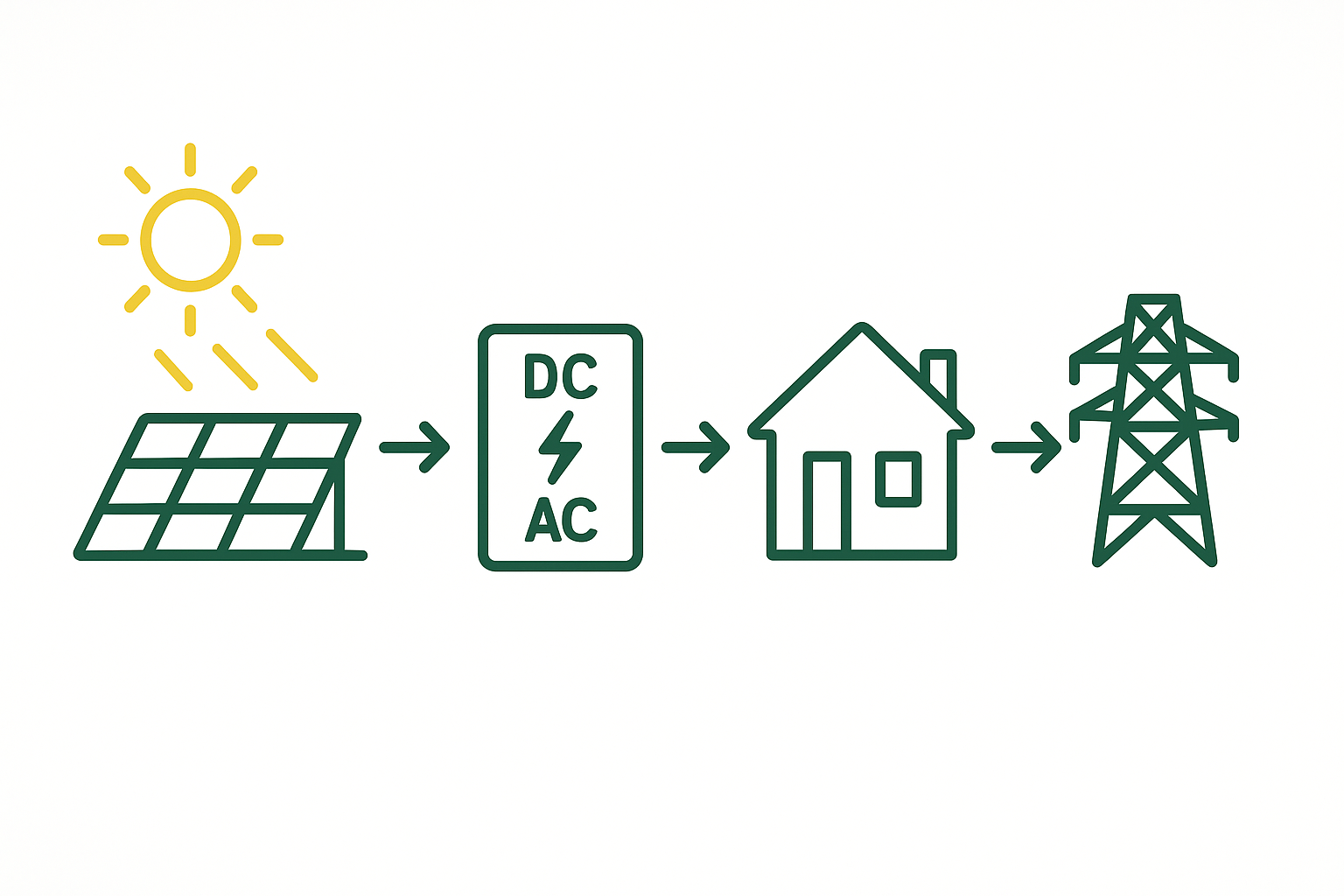
Panels convert sunlight to DC electricity. The inverter turns DC into AC for household use. A bidirectional meter accounts for grid imports and exports. Add a battery to store midday surplus for evening use; a controller prioritises self-consumption.
- Panels: choose reliable modules; efficiency matters less than total area and shading.
- Inverter: size to array and roof orientation; prefer reputable brands with local support.
- Metering: smart meter enables accurate billing and better monitoring.
Costs, subsidies, and payback (indicative ranges)

Final prices vary by roof, access, brand, and region. The table below gives planning ranges commonly quoted in 2025–2026 for typical single-family rooftops.
| System size (kWp) | Turnkey PV (incl. inverter) | Optional battery (5–10 kWh) | Annual yield (kWh/kWp) | Self-consumption w/o / w battery | Simple payback (yrs) |
|---|---|---|---|---|---|
| 6–8 | €9,000–€14,000 | +€3,500–€7,000 | 850–1,050* | 25–40% / 40–65% | 7–12 |
| 8–12 | €12,000–€19,000 | +€4,000–€8,500 | 850–1,050* | 30–45% / 45–70% | 6–11 |
*Yield depends on region, tilt, azimuth, and shading. Southern Germany and unshaded south-facing roofs tend to be higher.
Subsidies & tariff concepts (overview)
- VAT relief: residential PV components often benefit from 0% VAT (check current rules with your installer).
- Feed-in remuneration: exported kWh receive a tariff; rates depend on system setup and are periodically adjusted.
- Local grants / KfW: some municipalities or states offer bonuses; availability changes—ask your installer.
Installation & approvals—step-by-step

- Roof & demand assessment. Check usable area, shade, structural condition; estimate your yearly kWh.
- Quotes & design. Get 2–3 quotes with module brand, inverter size, monitoring, and cable plan.
- Permits & registrations. Your installer handles grid application, meter, and market register entries.
- Install & commissioning. Mount rails, panels, DC cabling, inverter, protection, and smart meter.
- Handover & training. App access, emergency shut-off location, maintenance schedule, and docs.
Battery storage—should you add it?

Batteries shift midday PV to evening loads. They add cost but can improve comfort and savings if you use energy after sunset (cooking, EV charging, heat pump). Consider:
- Right-sizing: 5–10 kWh covers most evening peaks for typical homes.
- Warranty & cycles: look for transparent cycle life and throughput limits.
- Backup option: some systems power critical circuits in outages—ask for a switchover plan.
Common mistakes (and easy wins)

- Underestimating shade: small trees or chimneys can reduce output—use shading simulation.
- Too small inverter: avoid chronic clipping; your installer should justify sizing.
- No smart loads: time dishwasher/EV/heat-pump to sunny hours for higher self-use.
- Poor cable routing: messy DC runs and no labels complicate service—ask for tidy work.
Future outlook (2026–2030)

Expect smarter tariffs (time-variant), wider smart-meter coverage, and better integrations with heat pumps and EVs. Module tech improves gradually; monitoring apps become more helpful. The overall direction: higher self-consumption, simpler admin, and more predictable returns.
FAQs: Rooftop solar for German homeowners
how-long-does-installation-take ▾
Physical installation is often 1–3 days for typical homes, plus lead time for permits, meter swap, and grid sign-off. Your installer can give a local estimate.
do-solar-panels-work-on-east-west-roofs ▾
Yes. Peak output is lower than south, but east-west splits can broaden production across the day—great for self-consumption with appliances and EV charging.
is-a-battery-required ▾
No. Many homes start with PV only and add storage later. If your evening use is high or you want outage support, size a 5–10 kWh battery from the start.
what-maintenance-is-needed ▾
Visual checks, occasional cleaning if dust/pollen builds up, and monitoring app alerts. Ask for annual inspection and clear fault procedures.
can-i-oversize-the-array ▾
Often yes—within electrical and regulatory limits. Slight oversizing versus inverter can be fine; your installer should show expected clipping and yield.
Sources & Method Notes (visual, no external links)
We use public, stable sources and conservative ranges. Exact figures depend on location, roof, equipment, and tariffs—confirm locally before purchase.
About the Author
Prashant Sharma
Student of Sustainable Business & Law. Exploring ESG compliance, environmental regulations, and corporate sustainability. Dedicated to making sustainable practices accessible and understandable.