Last Updated: June 9, 2026
Understanding the Canadian Competition Act: False or Misleading Representation Explained
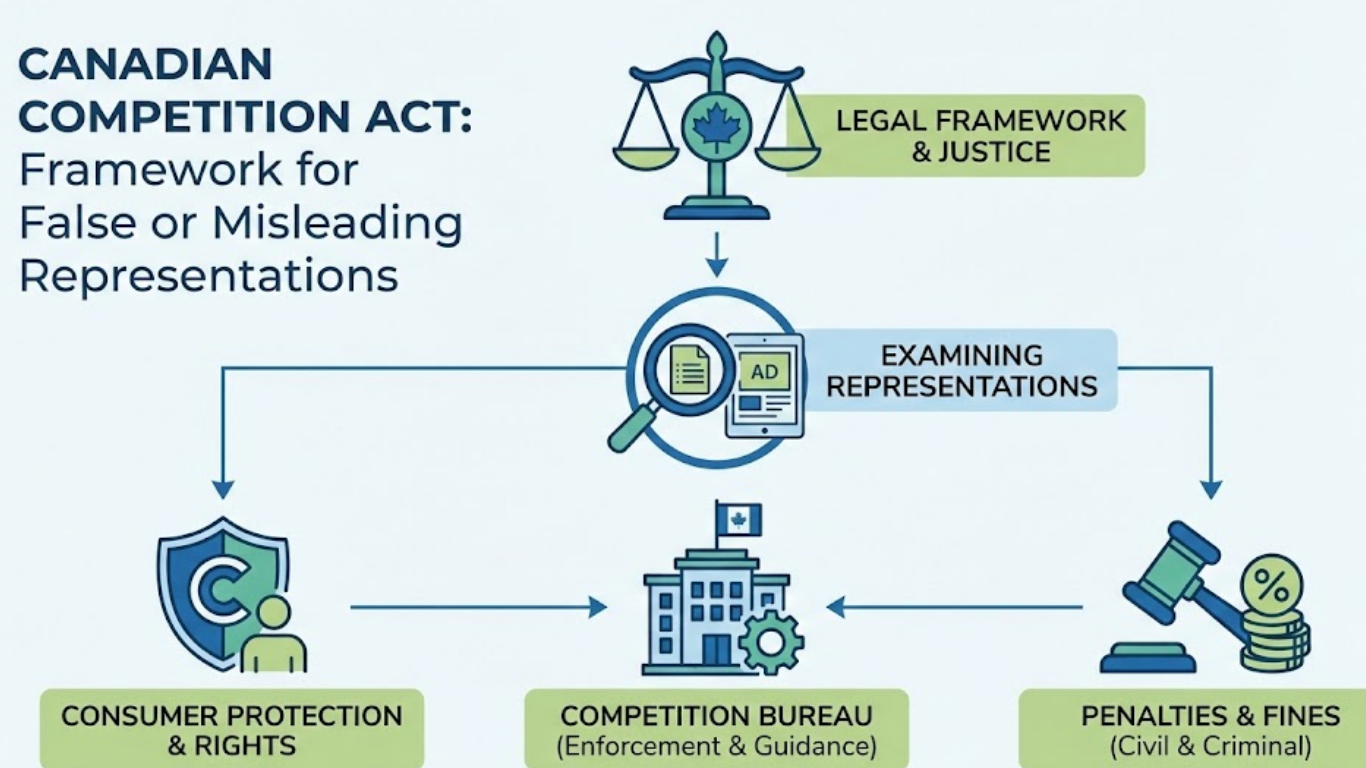
Key Takeaways
- The Canadian Competition Act prohibits false or misleading representations through both civil and criminal enforcement mechanisms
- Civil penalties can reach up to $10 million for corporations (first violation) and $15 million for subsequent violations
- Criminal penalties include unlimited fines and up to 14 years imprisonment for knowing or reckless violations
- Intent is NOT required for civil violations, making enforcement significantly easier
- New greenwashing provisions (June 2024) require environmental claims to be backed by adequate testing and internationally recognized methodology
- The Competition Bureau investigates complaints and can order corrective advertising and consumer restitution
- Private parties can now bring enforcement actions directly (as of June 2025)
Table of Contents
In an increasingly competitive digital marketplace, businesses often face the temptation to stretch the truth in their advertising claims. Whether it's promising results that can't be delivered, exaggerating product benefits, or making environmental claims without proper evidence, false or misleading advertising undermines consumer trust and violates Canadian law. The Canadian Competition Act contains powerful provisions designed to protect consumers and ensure fair competition by prohibiting false and misleading representations. Understanding these rules—and the substantial penalties for false or misleading advertising in Canada—is essential for any business operating in Canada.
This comprehensive guide explores the Canadian Competition Act's provisions on false or misleading representations, examines how the law is enforced, clarifies the distinction between civil vs criminal liability under Canadian Competition Act, and reveals the significant consequences faced by businesses that violate these standards. Whether you're a marketer, business owner, or someone concerned about deceptive marketing practices Canada, this article provides the knowledge you need to navigate this critical area of consumer protection law Canada.
What is the Canadian Act for False or Misleading Representation?
The Canadian Competition Act is the primary federal legislation governing Canadian false advertising law. While the Competition Act has existed since 1985, it has evolved significantly, particularly following amendments introduced in 2022 and 2024 to address modern marketing challenges like Canadian regulations on environmental claims in marketing and drip pricing.
The core purpose of the Act is twofold: to regulate healthy competition among Canadian businesses by preventing monopolies and cartels, and to establish comprehensive rules prohibiting false and misleading advertising that deceive consumers. The Act does this through two distinct adjudicative regimes—civil and criminal provisions false advertising—each with different thresholds, evidence requirements, and penalties.
The legislation applies broadly to all representations made to the public, regardless of the medium. This includes verbal statements, written claims, visual communications, photographs, illustrations, and even the tone of an announcer's voice. The Act recognizes that deceptive marketing can take many forms, and Canadian law has been deliberately structured to capture this diversity of deceptive marketing practices.
Which Law in Canada Prohibits False or Misleading Advertising?
At the federal level, the primary legislation prohibiting false or misleading advertising is the Competition Act (R.S.C. 1985, c. C-34). However, it's important to note that consumer protection is a shared responsibility between federal and provincial governments in Canada.
The Competition Act contains multiple provisions addressing deceptive marketing:
- Section 52(1) — Criminal prohibition on knowingly or recklessly making false or misleading representations
- Section 74.01(1)(a) — Civil provision prohibiting any false or misleading representations
- Sections 74.01(1)(b.1) and 74.01(1)(b.2) — New provisions (as of June 2024) specifically addressing environmental claims about products and business activities
- Section 74.04 — Prohibition on bait and switch selling
- Section 54 — Double ticketing
- Sections 55 and 55.1 — Multi-level marketing and pyramid selling restrictions
- Section 52.1 — Deceptive telemarketing
Additionally, each province and territory has its own consumer protection legislation that complements federal law. For example, provincial statutes often include similar prohibitions on false advertising specific to their jurisdictions.
Enforcement of the federal Competition Act falls under the jurisdiction of the Competition Bureau Canada, a department within Innovation, Science and Economic Development Canada (ISED). The Competition Bureau Canada investigates complaints and can pursue both civil and criminal provisions false advertising enforcement actions.
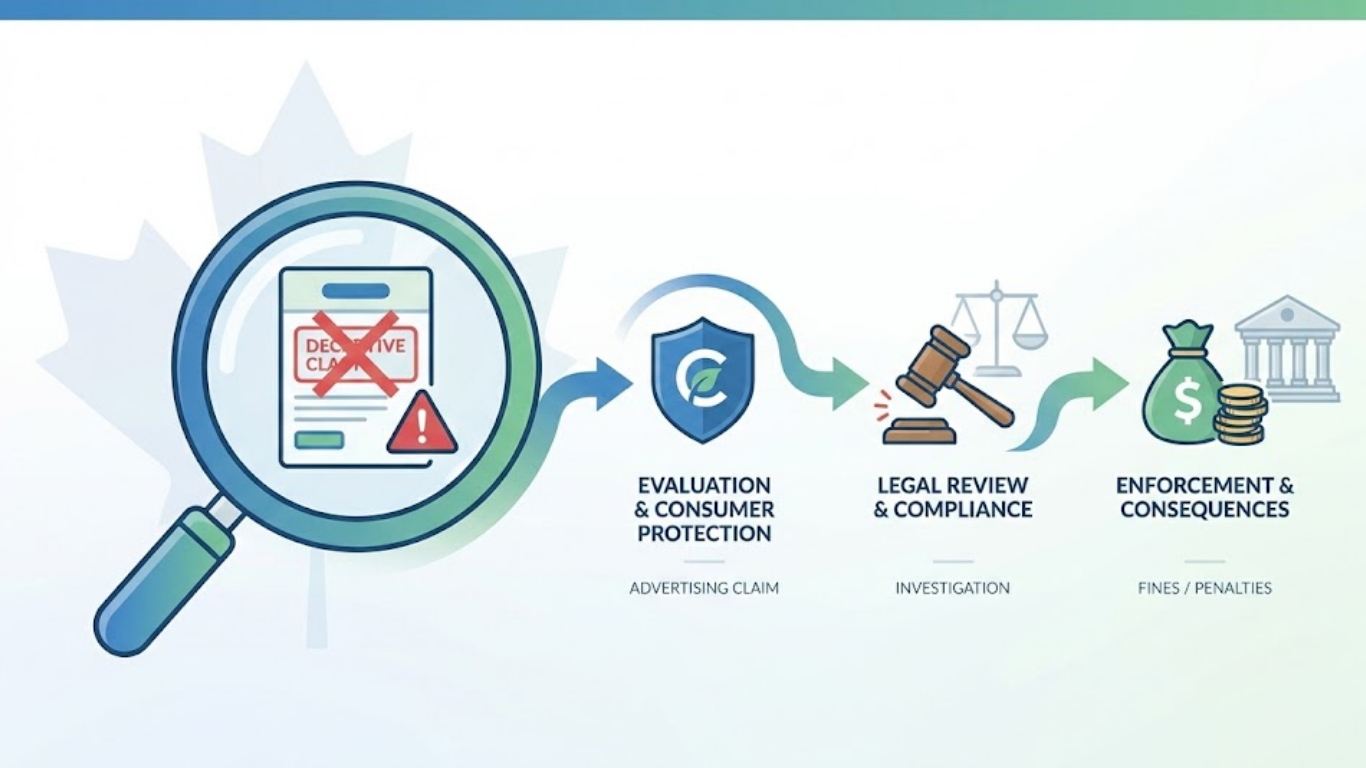
Infographic by sustainabilityplaybook illustrating the evaluation process of false or misleading representations under the Canadian Competition Act, highlighting consumer protection and enforcement steps
What Constitutes a False or Misleading Representation Under the Competition Act?
Understanding what the law considers "false or misleading" is crucial for compliance. The Competition Act prohibits representations that are materially false or misleading, and Canadian courts have established a clear legal framework for determining when this threshold is crossed.
Key Legal Elements:
1. A Representation Has Been Made
A representation can occur through any means: written statements, visual elements, testimonials, product labels, advertisements, or even the absence of information. The Act's broad language ensures that almost any form of communication promoting a product or business interest can be captured.
2. The Representation Was Made to the Public
Canadian courts have taken an expansive approach to defining "the public." This means the representation need not be broadcast to millions; it can be made to a single individual. The representation doesn't need to be made to someone in Canada, nor does it need to be made in a place accessible to the general public. This dramatically expands the reach of the law.
3. The Representation Is False or Misleading
A representation is false or misleading if it deceives or has a tendency to deceive. Importantly, the law evaluates both the literal meaning and the general impression conveyed by the representation. A representation can be literally true but still violate the law if the overall impression it creates is misleading.
4. The Representation Is "Material"
Material information is defined as information that could influence consumer behavior, such as persuading someone to buy or use a product or service. For example, claims about product quality, price, performance, origin, composition, or environmental benefits are typically material.
5. For Criminal Liability Only — "Knowingly or Recklessly"
The criminal provision (Section 52(1)) adds an additional requirement: the false or misleading representation must be made "knowingly or recklessly." This means the person making the representation must have had knowledge that it was false or misleading, or acted with recklessness regarding its truth. This mens rea (guilty mind) requirement is what distinguishes criminal from civil liability.
Important Clarifications:
Notably, the law does NOT require that:
- Any person was actually deceived or misled
- Any member of the public to whom the representation was made was within Canada
- The representation was made in a place to which the public had access
This means a business can be held liable even if the deceptive claim never actually fooled anyone or was made to a tiny audience.
What Are the Penalties for Violating the False or Misleading Representation Provisions?
The consequences of violating false or misleading representation provisions are severe and vary significantly depending on whether the violation is pursued as a civil or criminal matter.
CIVIL PENALTIES (Most Common)
The vast majority of false advertising cases in Canada are handled through civil enforcement, which is less burdensome to prove than criminal cases.
Under civil provisions (Section 74.01(1)(a)), the Competition Tribunal, Federal Court, or superior court of a province can order a business to:
- Stop engaging in the deceptive conduct
- Publish a corrective notice informing consumers of the truth
- Pay an administrative monetary penalty (AMP)
The penalty amounts are substantial:
For Individuals:
- First-time violation: Up to $750,000 (or three times the value of the benefit from the deceptive conduct, whichever is greater)
- Subsequent violations: Up to $1 million (or three times the benefit, whichever is greater)
For Corporations:
- First-time violation: Up to $10 million (or three times the benefit from the deceptive conduct, or 3% of annual worldwide gross revenue if the benefit cannot be determined, whichever is greater)
- Subsequent violations: Up to $15 million (or three times the benefit, whichever is greater)
Additionally, courts can order restitution, requiring the business to compensate consumers who purchased the falsely advertised products. In certain cases, courts can also issue interim injunctions to freeze assets.
CRIMINAL PENALTIES (Serious Cases)
Criminal prosecution under Section 52(1) is reserved for the most egregious cases involving clear evidence of knowing or reckless misconduct, particularly where the conduct is fraud-like in nature.
On Summary Conviction:
- Fine up to $200,000 and/or
- Imprisonment up to 1 year
On Conviction by Indictment:
- Fines at the discretion of the court (potentially unlimited) and/or
- Imprisonment up to 14 years
Criminal prosecution can also be brought against directors and officers of a corporation who were in a position to control or influence the behavior of those acting on behalf of the corporation.
Recent High-Profile Example:
The Competition Tribunal's 2024 decision against Cineplex Inc. exemplifies the severity of civil penalties. Cineplex was found to have contravened the misleading representations provisions through "drip pricing"—adding mandatory online booking fees not clearly disclosed during the purchasing process. The Tribunal ordered Cineplex to pay an administrative monetary penalty of $38.9 million, the highest AMP ordered to date under the Act.
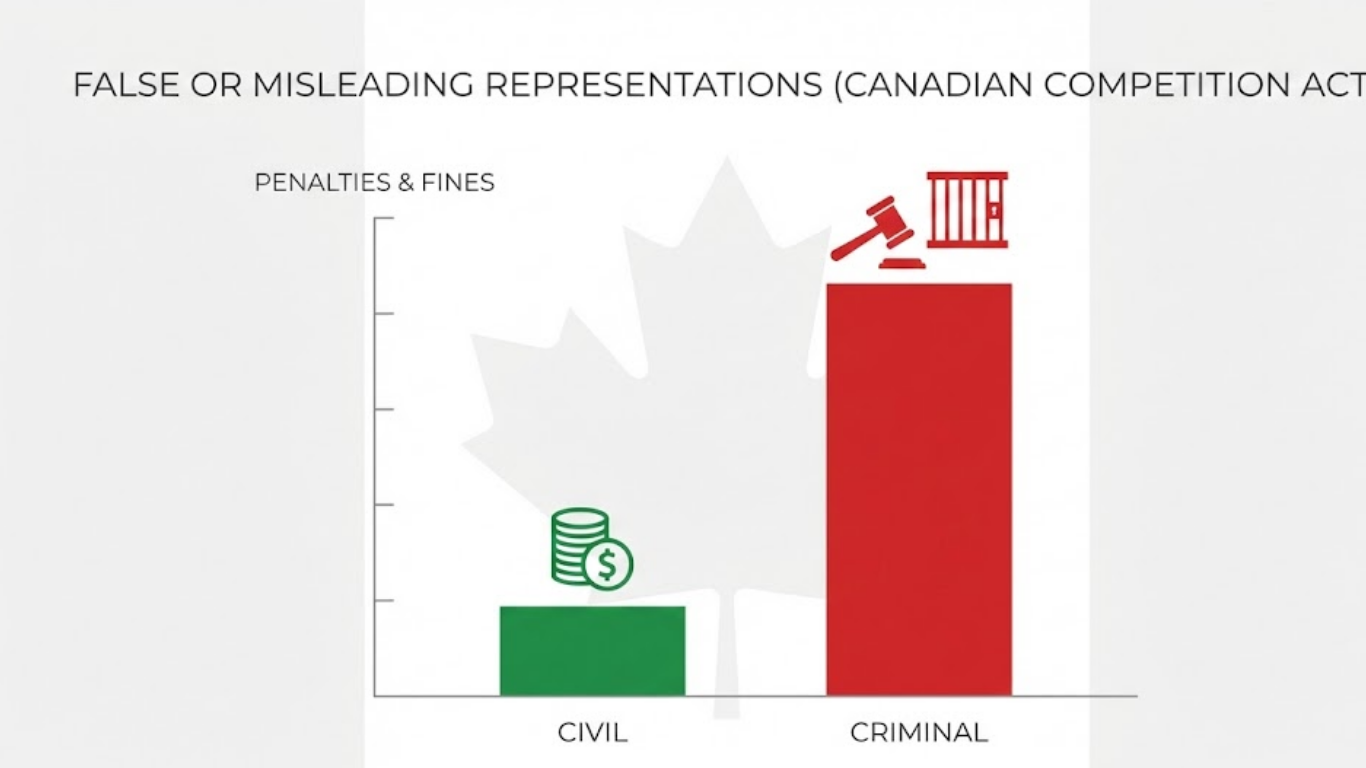
Penalties comparison chart by sustainabilityplaybook showing civil and criminal consequences under the Canadian Competition Act for false or misleading representations
Is Intent Required to Prove a False or Misleading Representation Offence?
The role of intent depends critically on whether the matter is pursued as a civil or criminal case.
Civil Cases:
For civil violations under Section 74.01(1)(a), intent is NOT required. The competition authority or tribunal only needs to prove that the representation was false or misleading in a material respect, on a balance of probabilities. The person making the representation cannot defend themselves by claiming they didn't know it was false or misleading, or that they didn't intend to deceive anyone.
Criminal Cases:
For criminal violations under Section 52(1), the prosecutor must prove that the representation was made "knowingly or recklessly". This requirement significantly raises the burden of proof:
- Knowing: The person making the representation knew it was false or misleading
- Recklessly: The person was aware of a substantial risk that the representation was false or misleading but proceeded anyway, displaying wanton or willful disregard for the truth
The Competition Bureau has published guidelines clarifying that it will only proceed on the criminal track when there is clear and compelling evidence of knowing or reckless conduct AND when criminal prosecution would be in the public interest. Factors considered include:
- Substantial harm caused by the conduct
- Whether vulnerable populations were targeted
- Whether the business attempted to remedy the conduct after becoming aware of it
- Whether similar conduct had occurred in the past
In practice, this means the vast majority of false advertising cases are handled civilly, with criminal prosecution reserved for repeat offenders or particularly egregious cases.
How Does the Act Define "Material" in False or Misleading Claims?
The concept of "materiality" is central to the Competition Act's false advertising provisions. A representation is only actionable if it is materially false or misleading.
Legal Definition:
Material information is defined as information that could influence consumer behavior, such as persuading a consumer to buy or use a product or service, or choose one product over another. The test is objective—the question is not whether the particular consumer in question was influenced, but whether the information is the type of information that typically influences purchasing decisions.
What Is Considered Material:
Courts typically find materiality when the representation concerns:
- Product composition — What is the product actually made of?
- Product origin — Where was it made? ("Made in Canada" claims)
- Product performance — What will the product actually do?
- Price — What is the actual cost to the consumer?
- Health or safety benefits — Will it cure a disease or prevent illness?
- Environmental benefits — Is it truly "carbon-neutral" or "plastic-free"?
- Durability and longevity — How long will the product last?
- Quality — Is it what it purports to be?
The General Impression Test:
An important aspect of materiality is that Canadian courts consider both the literal meaning of a representation and the general impression it conveys. This means a representation can fail the materiality test even if each individual statement is technically true, if the overall impression misleads consumers.
For example, a company advertising a "natural" juice drink that emphasizes "natural flavors" on the front of the package while disclosing "contains artificial sweeteners" in small print might violate the law if the general impression created is that the product is entirely natural.
What Types of Advertising Are Covered by the False or Misleading Representation Rules?
The Competition Act's scope is remarkably broad, encompassing virtually all forms of marketing and advertising.
Media Covered:
- Traditional media: Television, radio, newspapers, magazines, billboards
- Digital media: Websites, social media, email, online banners, sponsored content
- Point-of-sale: Product packaging, labels, in-store signage, shelf displays
- Direct communication: Telemarketing, direct mail, text messages
- Professional endorsements: Claims made by influencers, athletes, health professionals
- Visual and audio elements: Photographs, illustrations, graphics, music, tone of voice
Specific Practices Regulated:
Beyond general false or misleading representations, the Competition Act specifically regulates:
- Bait and Switch Selling — Advertising a product at a bargain price when it's not available in reasonable quantities and the business hasn't taken reasonable steps to obtain stock
- Double Ticketing — Displaying two or more prices on a product and supplying it at a price higher than the lowest advertised price
- Drip Pricing — Showing an attractive price but requiring customers to pay additional, undisclosed fixed charges or fees to complete a purchase
- Deceptive Telemarketing — Making false or misleading representations via phone calls or other telemarketing methods
- Misleading Warranties and Guarantees — Making false claims about warranty coverage or guarantees
- Performance Claims — Making claims about product performance not based on adequate and proper testing
- Testimonials and Tests — Using false, untrue, or unauthorized testimonials or test results to promote products
- Environmental Claims (Greenwashing) — Making false or unsubstantiated claims about environmental benefits of products or business activities
- Multi-Level Marketing Claims — Making misleading representations about earning potential in MLM schemes
- Pyramid Selling — Operating or promoting schemes where participants profit primarily through recruitment rather than product sales
What Remedies and Penalties Are Available Under the Criminal vs Civil Provisions?
Understanding the remedial differences between criminal and civil enforcement is essential for grasping the full scope of potential consequences.
| Aspect | Civil Provisions (Section 74.01) | Criminal Provisions (Section 52) |
|---|---|---|
| Burden of Proof | Balance of probabilities (50%+) | Beyond reasonable doubt |
| Requires Intent | No | Yes (knowingly or recklessly) |
| Adjudication Body | Competition Tribunal, Federal Court, or Superior Court | Criminal Court |
| Penalties for Individuals | Up to $750,000 (first), $1,000,000+ (subsequent) | Up to $200,000 & 1 year (summary); unlimited fines & 14 years (indictment) |
| Penalties for Corporations | Up to $10,000,000 (first), $15,000,000+ (subsequent) | Unlimited fines and imprisonment of officers up to 14 years |
| Corrective Advertising | Yes, courts can order corrective notices | Possible, but less common |
| Restitution to Consumers | Yes, courts can order compensation | Possible in sentencing phase |
| Frequency of Use | Very common | Rare; reserved for serious cases |
Key Differences:
1. Evidentiary Threshold: Civil cases require only that the representation be proven false or misleading "on the balance of probabilities"—essentially, it's more likely true than not. Criminal cases require proof "beyond a reasonable doubt," a much higher threshold.
2. Intent: The criminal track requires demonstrating that the representation was made knowingly or recklessly, adding substantial complexity to prosecutions. The civil track eliminates this burden entirely.
3. Remedial Options: Both regimes allow courts to order cessation of conduct and corrective advertising. However, civil proceedings are more flexible in crafting remedies tailored to the specific harm caused.
Symbolic courtroom imagery by sustainabilityplaybook representing justice and legal review under the Canadian Competition Act
Are Environmental Claims or "Green" Marketing Subject to These Rules?
Absolutely—environmental claims are subject to particularly strict scrutiny under updated Competition Act provisions.
The competition landscape changed dramatically in June 2024 when the Competition Act was amended to include specific provisions targeting greenwashing—making false or exaggerated environmental claims to appear more environmentally responsible than a business actually is.
General Rule — Section 74.01(1)(a):
All environmental claims remain subject to the general false or misleading representations prohibition. This means any claim about environmental benefits must be truthful and not misleading in either its literal meaning or general impression.
Specific Rules for Environmental Claims (New Provisions):
1. Product Environmental Benefits — Section 74.01(1)(b.1) (NEW - June 2024):
Claims about a product's benefits for protecting or restoring the environment, or mitigating environmental, social, and ecological causes or effects of climate change, must be based on adequate and proper testing.
Examples of claims that trigger this provision:
- "Plastic-free"
- "Carbon-neutral"
- "Biodegradable"
- "Made from recycled materials"
- "Compostable"
2. Business Environmental Benefits — Section 74.01(1)(b.2) (NEW - June 2024):
Claims about the environmental benefits of a business or business activity must be substantiated in accordance with internationally recognized methodology.
Examples of claims:
- "Net-zero operations"
- "Green supply chain"
- "Sustainable practices"
- "Carbon-neutral company"
"Internationally recognized methodology" generally includes methodologies recognized in two or more countries.
Competition Bureau Environmental Guidelines:
In June 2024, the Competition Bureau released updated Environmental Guidelines outlining six principles of compliance for environmental claims:
- Environmental claims should be truthful and not false or misleading — Both literal meaning and general impression matter
- Environmental benefits of products and performance claims should be adequately and properly tested — Use reliable methods and evidence
- Comparative environmental claims should be specific — Clearly state what is being compared
- Environmental information must be presented clearly and prominently — Key information needed to prevent misleading impressions must not be hidden
- Due diligence is a defense — Companies can mitigate liability by demonstrating they exercised due diligence to prevent deceptive claims through verification and substantiation
- Businesses are not required to disclose evidence publicly — However, they must retain proper evidence to support claims and produce it if requested by regulators
Real-World Impact:
Greenwashing violations now carry the same severe penalties as other false advertising. The Cineplex case and expanded private rights of action (effective June 2025) have signaled that the Competition Bureau and private parties will vigorously pursue greenwashing claims.
What Is the Role of the Competition Bureau in Enforcing False or Misleading Advertising Laws?
The Competition Bureau is Canada's primary enforcement body for false or misleading advertising violations under the Competition Act.
Mandate:
The Competition Bureau is a federal department that administers and enforces the Competition Act across Canada. It is responsible for investigating allegations of deceptive marketing practices and determining whether to pursue civil or criminal enforcement.
Investigation Process:
- Complaint Filing: Consumers, competitors, or other parties can file complaints with the Competition Bureau online, by telephone, or through written submissions.
- Initial Assessment: The Bureau assigns an intake officer to evaluate whether the complaint has merit and falls within the Bureau's jurisdiction.
- Investigation Decision: Based on volume, merit, and public interest, the Bureau may decide to:
- Not act on the complaint
- Commence an informal investigation
- Initiate a formal inquiry
- Formal Inquiry: If a formal inquiry is opened, the Bureau gains significant investigative powers, including the ability to compel testimony and document production.
- Enforcement Track Decision: The Bureau decides whether to pursue civil or criminal enforcement based on the evidence, severity, and public interest.
Civil vs Criminal Track Decisions:
The Competition Bureau publishes guidelines clarifying that it will pursue the criminal track only when:
- There is clear and compelling evidence of knowing or reckless conduct
- Criminal prosecution would be in the public interest
Factors in the public interest assessment include:
- Substantial harm caused
- Targeting of vulnerable populations
- Repeated violations
- Failure to remediate after warnings
Confidentiality:
The Competition Bureau conducts investigations in private and protects the confidentiality of complaint sources and information provided. However, if the Bureau decides to pursue enforcement, information may be disclosed in court proceedings.
Expanded Enforcement — Private Rights of Action:
As of June 20, 2025, private parties can directly bring claims to the Competition Tribunal for certain violations (including greenwashing), reducing reliance on Competition Bureau investigations and creating additional enforcement pressure on businesses.
Practical Compliance Strategies
For businesses seeking to avoid violations of false or misleading representation provisions, several practical steps are essential:
1. Truthfulness and Clarity:
- Ensure all marketing claims are truthful in both literal meaning and general impression
- Avoid exaggeration or puffery that could mislead reasonable consumers
- Disclose material limitations or conditions prominently
2. Substantiation and Testing:
- Maintain proper documentation supporting all claims, especially performance and environmental claims
- Use adequate and proper testing for product environmental benefits
- Use internationally recognized methodology for business-level environmental claims
- Retain evidence for at least the duration of any potential investigation or litigation
3. Due Diligence:
- Implement internal compliance programs to verify claims before marketing
- Train marketing, sales, and management personnel on Competition Act requirements
- Review advertising materials for compliance before publication
- Monitor social media and third-party testimonials for false claims
4. Transparency:
- Present material information clearly and not hidden in fine print
- Use accurate pricing displays and clearly disclose all mandatory fees (addressing drip pricing concerns)
- Provide honest warranty and guarantee information
- Avoid comparative advertising claims that lack specificity or proper substantiation
5. Record-Keeping:
- Maintain detailed records of testing and substantiation for all claims
- Document internal compliance reviews and approval processes
- Preserve communications regarding decision-making about claims
- Track consumer complaints and responses
6. Legal Review:
- Consult with legal counsel experienced in Competition Act compliance before launching major marketing campaigns
- Seek pre-approval from the Competition Bureau if claims are novel or potentially controversial
- Review competitor practices for context but do not mimic their potentially problematic claims
Reporting False Advertising to the Competition Bureau
If you suspect false or misleading advertising in violation of the Competition Act, the Competition Bureau welcomes complaints.
How to File a Complaint:
- Online: Visit the Competition Bureau website and submit a detailed written complaint through the online portal
- Telephone: Call the Competition Bureau and speak with an intake officer
- Written Submission: Mail a formal complaint letter detailing the alleged violation and relevant facts
Conclusion
The Canadian Competition Act's provisions on false or misleading representations represent one of the most comprehensive frameworks for protecting consumers and ensuring fair competition in North America. Whether pursued through civil or criminal enforcement, violations carry severe penalties: multi-million-dollar fines for corporations, potential imprisonment for individuals, corrective advertising obligations, and restitution to harmed consumers.
The landscape has shifted dramatically in 2024-2025, with new provisions targeting greenwashing, expanded private enforcement rights, and heightened Competition Bureau vigilance. Businesses can no longer rely on ambiguous or technically true-but-misleading claims to gain competitive advantage.
For consumers, the regulatory framework offers meaningful protection and new avenues for private enforcement. For businesses, the message is clear: invest in compliance, substantiate your claims, and prioritize truthfulness in all marketing communications. The cost of violations—both financial and reputational—far exceeds the investment in building a compliant marketing operation.
Whether you are a marketer concerned about regulatory compliance, a consumer harmed by deceptive practices, or a business owner committed to ethical marketing, understanding the Canadian Competition Act's false or misleading representation provisions is essential to navigating today's business environment.
For more information or to file a complaint, visit the Competition Bureau's website or contact them directly. Stay informed about evolving guidelines and amendments to ensure your business remains compliant with Canada's consumer protection standards.
References
- Competition Bureau Canada. (2024). "False or misleading representations." Retrieved from competition-bureau.canada.ca
- Lexpert. (2023). "Laws on false advertising: what you need to know." Lexpert Magazine. Retrieved from www.lexpert.ca
- LexisNexis Canada. (2025). "Misleading Advertising and Deceptive Marketing." Legal Brief. Retrieved from www.lexisnexis.ca
- Government of Canada. (2025). "Competition Act (R.S.C., 1985, c. C-34)." Justice Laws Website. Retrieved from laws-lois.justice.gc.ca
- Competition Bureau Canada. (2024). "Penalties and remedies for non-compliance." Retrieved from competition-bureau.canada.ca
- Marks & Clerk. (2025). "Canada's Competition Bureau issues new environmental claims guidelines." Insights. Retrieved from www.marks-clerk.com
- BD&P. (2025). "Canada Issues Guidelines on Civil Greenwashing Claims." Retrieved from www.bdlaw.com
- Davies Ward Phillips & Vineberg LLP. (2024). "Hold My Popcorn: Canadian Competition Tribunal Decides First Drip Pricing Case." Retrieved from www.dwpv.com
- Competition Bureau Canada. (2022). "Bait and switch selling." Retrieved from competition-bureau.canada.ca
- Blakes. (2025). "Canada Expands Private Litigation Regime Under Competition Act." Retrieved from www.blakes.com
- Canadian Advertising Law. (2025). "Competition Bureau Complaints." Retrieved from www.canadianadvertisinglaw.com
- Lexpert. (2024). "A guide on Canadian false marketing law for businesses." Lexpert Magazine. Retrieved from www.lexpert.ca
About the Author
Prashant Sharma
Student of Sustainable Business & Law. Exploring ESG compliance, environmental regulations, and corporate sustainability. Dedicated to making sustainable practices accessible and understandable.