Last Updated: June 9, 2026
German Act Against Unfair Competition (UWG): Complete Guide to Germany's Anti-Greenwashing & Consumer Protection Law 2025
🌿 Key Takeaways
- The UWG protects three groups: competitors, consumers, and market participants from unfair business practices including misleading advertising and aggressive sales tactics.
- Penalties for violations include fines up to €50,000 or 4% of annual turnover, plus injunctive relief, damages, and contractual penalties under reformed 2022 provisions.
- The 2020 reform restricted standing under Section 8(3) UWG, requiring competitors to sell goods "to a not inconsiderable extent and not only occasionally" to prevent abusive litigation.
- Greenwashing is explicitly prohibited under Sections 5 and 5a UWG, requiring scientific substantiation for environmental claims like "climate neutral" or "eco-friendly."
- The UWG blacklist in the Annex to Section 3(3) lists 30+ automatically prohibited practices including falsified reviews, hidden advertising, and pyramid schemes.
- Section 13a caps contractual penalties at €1,000 for minor violations against small competitors with fewer than 100 employees, addressing abusive cease-and-desist practices.
- B2C rules are stricter than B2B standards, presuming consumers need greater protection with detailed prohibitions versus general fairness requirements for business dealings.
📚 Table of Contents
- Understanding the German UWG
- Standing Requirements Under Section 8
- Unfair Competition Practices
- B2B vs B2C Rules
- Penalties and Enforcement
- Misleading Advertising Regulations
- Recent UWG Amendments
- Greenwashing and Green Claims
- Relationship with EU Directives
- Legal Remedies Available
- The UWG Blacklist
- Abusive Warning Notices
- Frequently Asked Questions
Understanding the German UWG
The Gesetz gegen den unlauteren Wettbewerb (Act Against Unfair Competition) serves as Germany's primary legal instrument for regulating fair competition and protecting market integrity. Enacted in its current form in 2004 and substantially reformed in 2020 and 2022, the UWG establishes comprehensive rules governing commercial conduct between businesses and toward consumers. The statute belongs to Germany's commercial law (Gewerberecht) and competition law framework (Wettbewerbsrecht), specifically the fairness law subsection (Lauterkeitsrecht) that defines market conduct rules.
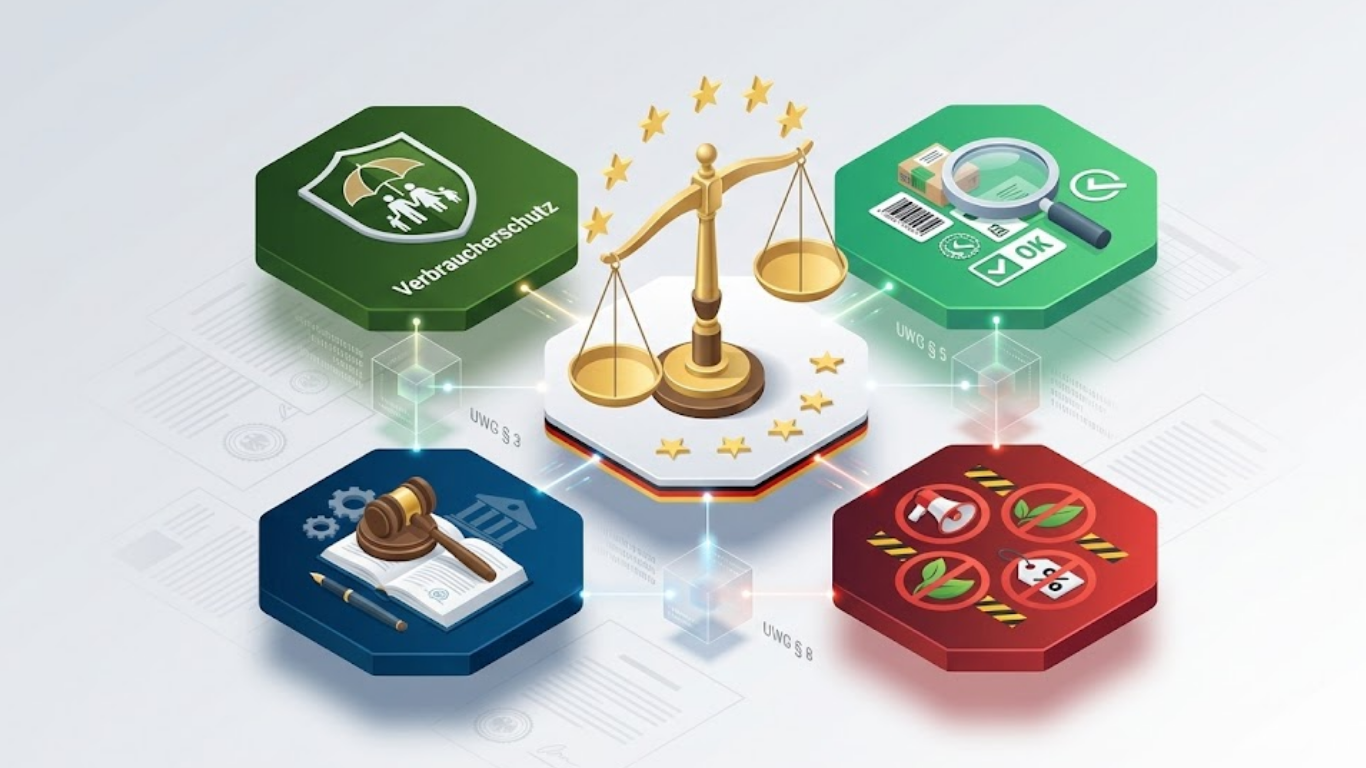
Section 1 UWG articulates the law's threefold purpose: protecting competitors from unfair competition, protecting consumers and market participants from unfair commercial practices, and safeguarding the public interest in undistorted competition. This triadic protection approach distinguishes German unfair competition law from purely consumer protection statutes, recognizing that fair market conditions benefit all participants. The UWG implements several EU directives while maintaining Germany's historically stricter national standards in certain areas, particularly regarding competitor enforcement rights and cease-and-desist procedures.
Standing Requirements Under Section 8
Section 8 UWG delineates who possesses standing (Anspruchsberechtigung) to assert claims for unfair competition violations, with the 2020 reform significantly restricting competitor access to prevent litigation abuse. Under Section 8(3) No. 1 UWG, competitors now must demonstrate they sell or demand goods or services "to a not inconsiderable extent and not only occasionally" rather than merely competing in the same market. This heightened threshold excludes occasional market participants and entities engaging in minimal commercial activity from asserting competitive claims.
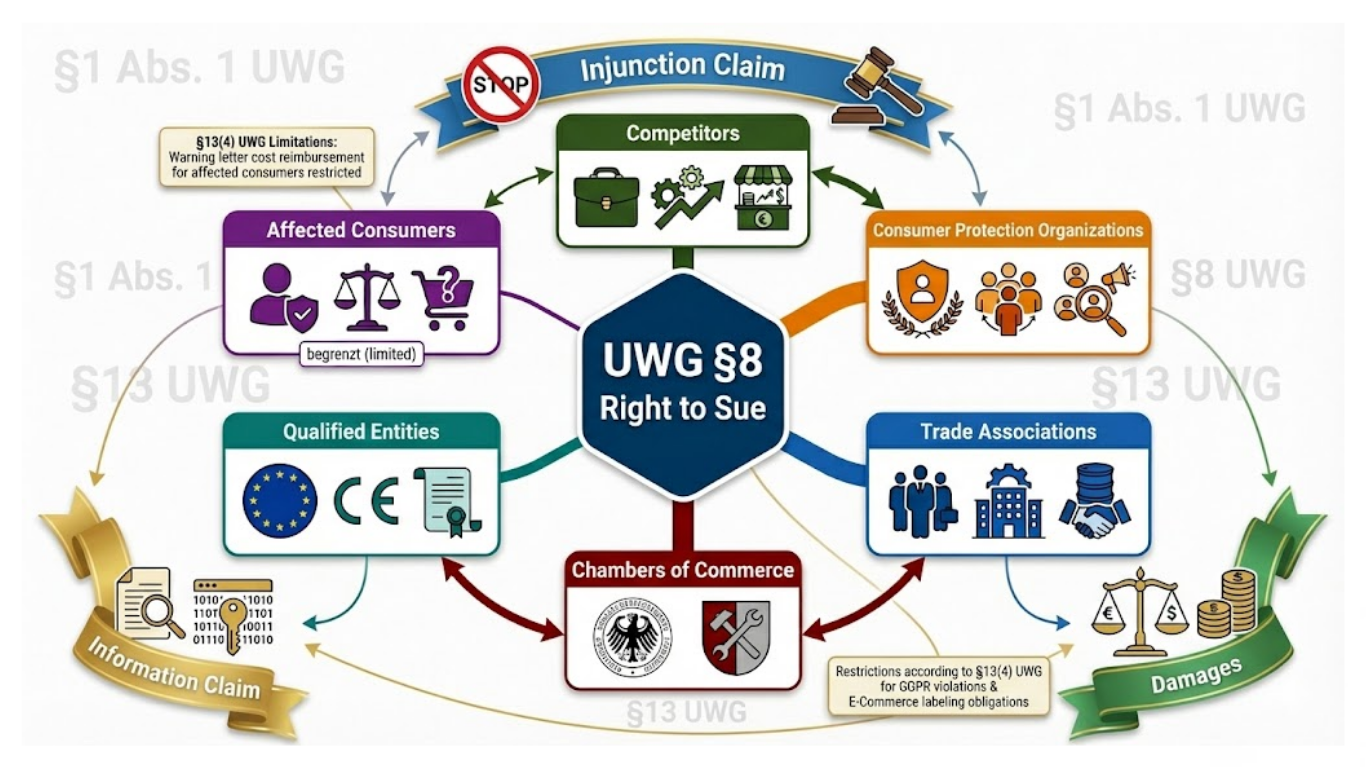
Consumer protection associations and trade associations maintain standing under Section 8(3) No. 2 UWG, provided they are entered in the list of qualified economic associations pursuant to Section 8b UWG maintained by the Federal Office of Justice. Section 8b prescribes specific conditions for list inclusion, including that associations represent a significant number of enterprises trading goods or services of the same or related types and possess sufficient personnel, material, and financial resources to perform their statutory duties effectively. This centralized registration system shifts standing examination from courts to administrative authorities, streamlining judicial proceedings and preventing frivolous claims by unqualified entities.
Qualified entities under Section 8(3) No. 3 UWG, including certain tenant associations and consumer protection organizations, possess standing when entered in the Federal Office of Justice list pursuant to Section 4 UKlaG (Injunctions Act for Consumer Protection) or qualified entities from other EU Member States listed per Article 4(3) of Directive 2009/22/EC. Additionally, chambers of commerce and industry (IHK) and chambers of crafts (HWK) maintain standing under Section 8(3) No. 4 UWG for violations affecting their member interests. Notably, individual consumers lack direct standing under the UWG and must channel complaints through qualified consumer protection associations or pursue alternative remedies under civil law.
Unfair Competition Practices
Section 3 UWG establishes the fundamental prohibition: "Unlawful commercial practices are prohibited." Section 3(1) defines commercial practices as unlawful when they are unfair, with Section 3(2) specifying that unfairness arises when practices are not compatible with professional diligence and materially distort or are likely to materially distort consumers' economic behavior. The law categorizes unfair practices into several prohibited categories including misleading actions, misleading omissions, aggressive practices, and specific blacklisted conduct.
Section 4 UWG prohibits specific unfair practices including obstruction of competitors through targeted employee poaching, boycott calls, or patent blocking aimed at market exclusion. While employee mobility between competitors is lawful, systematic poaching with intent to harm constitutes unfairness, particularly when involving exploitation of trade secrets, inducement to breach contracts, or mass defection of key personnel. Section 4a UWG prohibits aggressive commercial practices characterized by harassment, coercion, undue influence through threats or intimidation, or exploitation of positions of power to impair consumer decision-making freedom.
Section 7 UWG addresses undue annoyance, prohibiting unreasonable harassment through commercial communications. Telephone advertising to consumers without prior express consent constitutes prohibited harassment, as does email marketing without opt-in authorization or newsletter subscription. However, non-addressed advertising materials inserted into physical mailboxes remain generally permissible unless recipients display no-advertising notices. The UWG distinguishes permissible competitive tactics like targeted recruitment of competitors' skilled employees and comparative advertising from prohibited unfair methods, maintaining balance between competitive dynamism and market fairness.
B2B vs B2C Rules
The UWG establishes differentiated protection standards for business-to-consumer (B2C) transactions versus business-to-business (B2B) dealings, reflecting varying sophistication levels and protective needs. B2C regulations provide heightened consumer safeguards through detailed prohibitions in the blacklist Annex to Section 3(3) UWG, listing over thirty automatically unfair practices without requiring individual case assessment. This categorical approach presumes consumers face information asymmetries and vulnerability requiring ex ante protection against specified deceptive or manipulative techniques.
| Aspect | B2C (Business-to-Consumer) | B2B (Business-to-Business) |
|---|---|---|
| Protection Standard | Strict consumer protection with blacklist | General fairness standard under Section 3 |
| Prohibited Practices | 30+ automatically prohibited blacklist items | Practices violating decent business customs |
| Burden of Proof | Lower burden; blacklist violations automatic | Must prove unfairness and harm |
| Information Requirements | Extensive disclosure obligations Sections 5a, 5b | Presumption of business sophistication |
| Remedies | Injunctions, damages, administrative fines | Primarily injunctions and damages |
B2B unfair competition standards employ more concise prohibitions, with Section 3 UWG requiring only that commercial practices not violate "decent customs" (die guten Sitten) in trade, commerce, or craftsmanship. This open-ended standard presumes businesses possess greater expertise, resources, and negotiating parity, thus requiring less prescriptive protection than consumers. Courts evaluate B2B fairness through case-by-case assessment considering industry customs, competitive impact, and whether practices undermine trust in fair dealing.
Penalties and Enforcement
The 2022 UWG amendment introduced substantially enhanced penalties for consumer interest violations, implementing EU Directive 2019/2161 (Omnibus Directive) enforcement requirements. Section 19(1) UWG establishes that intentional or negligent violations of consumer interests under Section 5c(1) constitute administrative offenses punishable under Section 19(2) with fines up to €50,000 or, if applicable, up to 4% of the violator's annual turnover in the preceding business year. This turnover-based fine calculation mechanism ensures penalties remain proportionate and deterrent across different business scales.
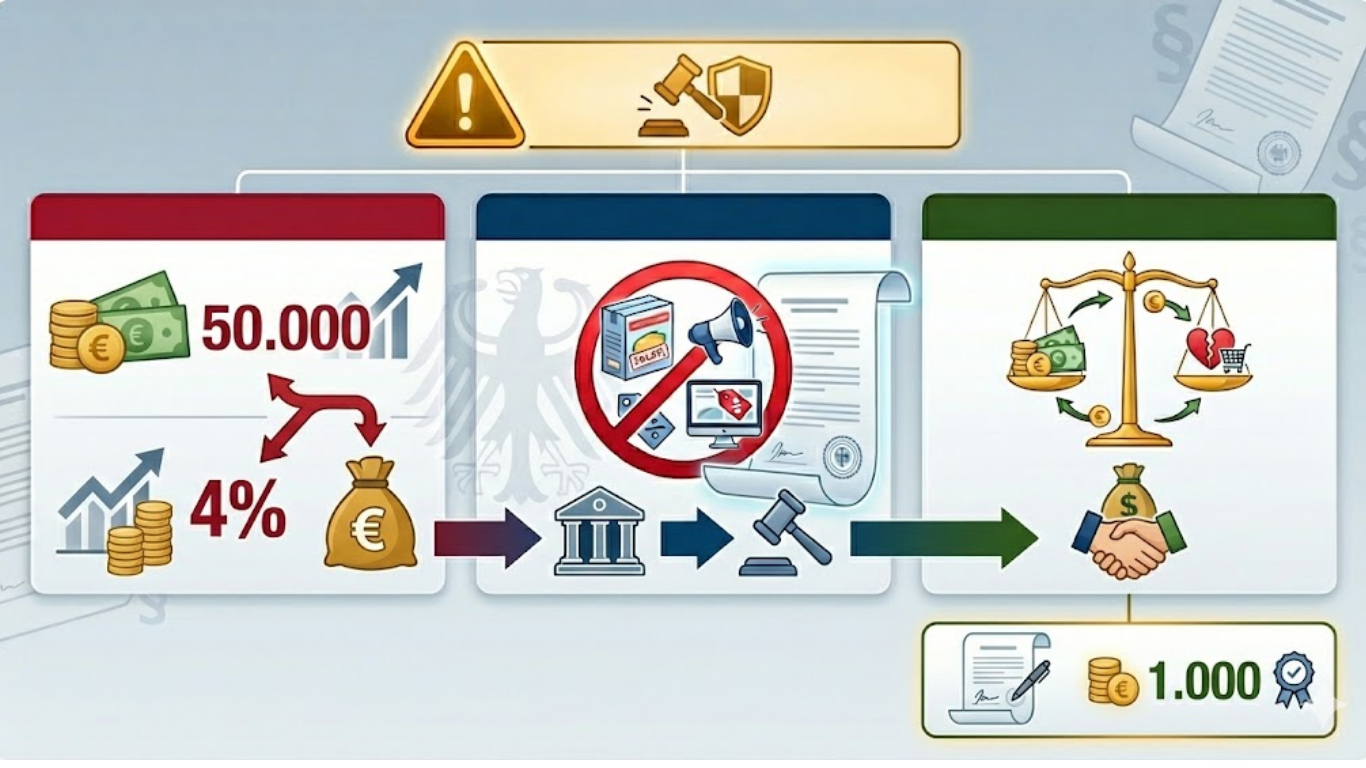
Section 5c(2) UWG defines "violation of consumer interests" as encompassing blacklist offenses, aggressive commercial acts under Section 4a, misleading conduct under Sections 5 and 5a, and unfair commercial acts under Section 3 that continue despite enforceable official orders or court prohibitions. Notably, first-time violations or violations promptly remedied may avoid maximum fines, with enforcement authorities exercising discretion based on violation severity, duration, and violator culpability.
Beyond administrative fines, civil law remedies under Sections 8 and 9 UWG provide injunctive relief (Unterlassungsanspruch), compensatory damages (Schadensersatz), and information claims (Auskunftsanspruch). Section 12 UWG permits preliminary injunctions (einstweilige Verfügung) for urgent cases requiring immediate cessation of unlawful conduct before full litigation. Additionally, profit disgorgement to the federal treasury applies in certain cases under Section 10 UWG, depriving violators of ill-gotten gains even when private parties cannot quantify specific damages.
Misleading Advertising Regulations
Sections 5 and 5a UWG constitute the core provisions prohibiting misleading commercial communications through both actions and omissions. Section 5 UWG prohibits misleading commercial practices that contain false information or are likely to deceive the average consumer regarding product characteristics, price, availability, or trader identity. The provision applies to explicit false statements as well as statements that create misleading impressions through presentation, context, or emphasis even when literally true.
Section 5(1) UWG enumerates specific misleading categories including false statements about existence or nature of goods or services, main characteristics including availability and benefits, price calculation or manner of price fixing, need for service or replacement, nature of sales process or statement, trader's identity or qualifications, consumer rights or risks, and geographical or commercial origin. Courts employ the "average consumer" standard—reasonably well-informed, observant, and circumspect—when assessing whether communications mislead, though lower thresholds apply for vulnerable consumer groups like children.
Section 5a UWG addresses misleading omissions where material information necessary for informed transactional decisions is withheld, hidden, provided ambiguously or untimely, or fails to identify commercial intent when not apparent from context. Material information includes that which the average consumer needs for informed decisions under the circumstances, considering limitations of communication medium. Section 5b UWG supplements these provisions with specific requirements for invitations to purchase, mandating disclosure of main product characteristics, trader identity and address, total price or calculation method, payment and delivery arrangements, and complaint handling procedures.
Recent UWG Amendments
The Gesetz zur Stärkung des fairen Wettbewerbs (Act to Strengthen Fair Competition) enacted in 2020 fundamentally reformed UWG enforcement mechanisms to combat abusive litigation while maintaining robust substantive protections. The reform restricted competitor standing under Section 8(3) No. 1 UWG, introduced centralized registration of qualified associations and entities under Section 8b, and established comprehensive anti-abuse provisions for cease-and-desist letters in Sections 8c and 13a. These changes responded to criticisms that the UWG's private enforcement model enabled "warning letter industries" profiting from mass cease-and-desist campaigns rather than genuine competition protection.
The 2022 amendment implementing Directive (EU) 2019/2161 (Omnibus Directive) introduced administrative fine provisions in Section 19 UWG and expanded the consumer protection blacklist with new prohibitions. Blacklist addition No. 11a prohibits hidden advertising in search results, requiring clear disclosure when traders pay for preferential ranking. Nos. 23b and 23c address falsified customer reviews, prohibiting claims that reviews originate from actual purchasers without reasonable verification measures and submission of non-genuine reviews to misrepresent consumer opinions.
Section 5b(2) UWG was supplemented with ranking disclosure requirements, and Section 5c introduced the "violation of consumer interests" concept triggering enhanced administrative penalties. These modernizations align German law with pan-European consumer protection standards while preserving Germany's traditionally stricter approach in certain domains. Looking ahead, implementation of the forthcoming Green Claims Directive and Empowering Consumers Directive will require further UWG amendments, particularly regarding environmental advertising substantiation and greenwashing prevention.
Greenwashing and Green Claims
Environmental advertising faces intensifying scrutiny under UWG provisions prohibiting misleading conduct, with 2025 bringing accelerated enforcement against greenwashing following Green Claims Directive adoption at EU level. Claims such as "climate neutral," "environmentally friendly," "sustainable," or "100% eco" constitute actionable misleading advertising under Sections 5 and 5a UWG when lacking scientific substantiation, transparent methodology disclosure, or independent verification. Generic environmental superiority claims without specific, quantified environmental benefits are presumptively misleading absent comprehensive lifecycle assessment documentation.
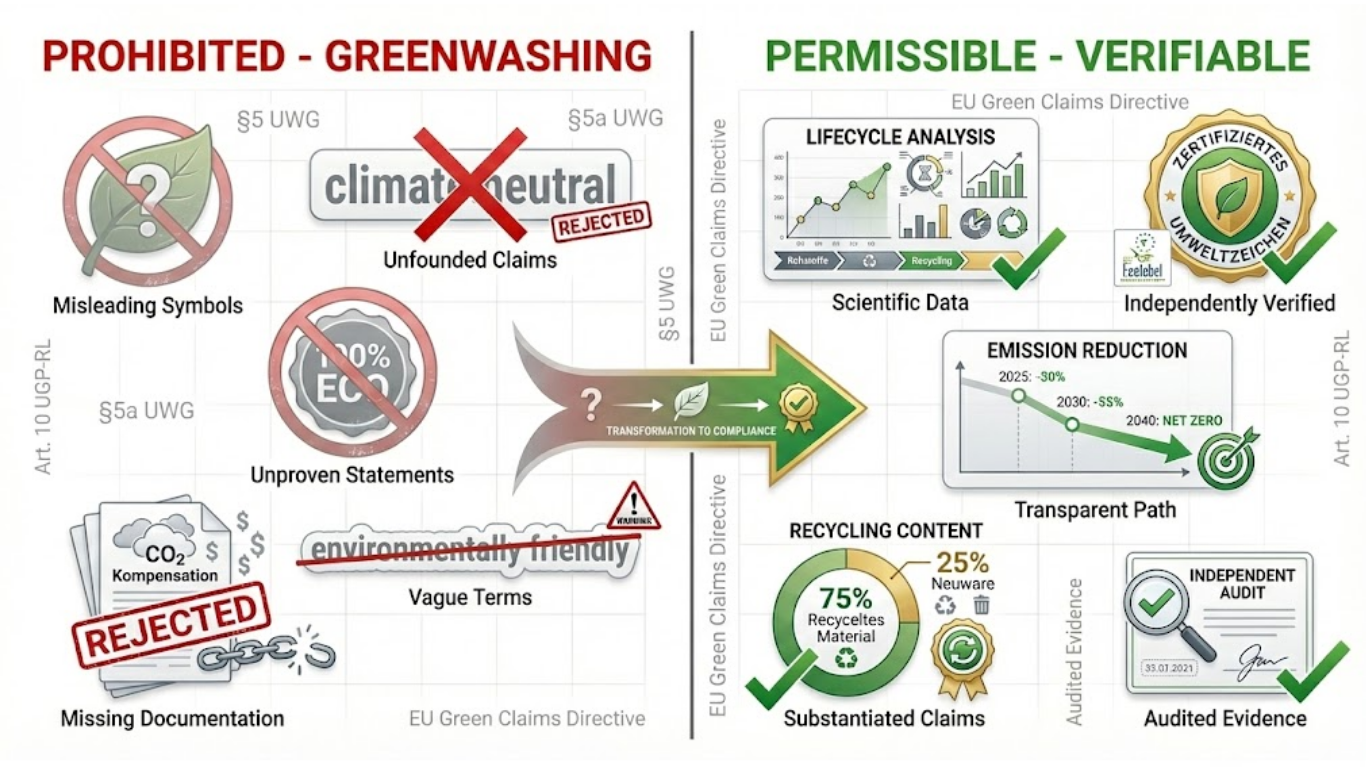
Carbon neutrality claims require disclosure of underlying calculation methodologies, scope boundaries (direct emissions versus lifecycle), offset quality and additionality verification, and temporal achievement pathways. Claims relying predominantly on carbon offsets without absolute emissions reductions face particular skepticism, as do offsets lacking third-party certification or involving questionable permanence. The forthcoming Green Claims Directive will mandate pre-approval of environmental claims by independent verifiers and prohibit generic sustainability labels absent specific environmental impact demonstration.
Comparative environmental claims face additional substantiation burdens under Section 6 UWG governing comparative advertising, requiring verifiable, objective comparison of material, relevant, and representative features. Environmental superiority assertions like "greener than competitors" must specify environmental parameters measured, provide comparable data for referenced competitors, and avoid selective disclosure highlighting favorable metrics while omitting unfavorable impacts. As enforcement agencies and consumer protection associations increasingly target greenwashing, businesses marketing sustainability credentials must ensure comprehensive documentation supporting every environmental claim.
Relationship with EU Directives
The UWG implements multiple EU directives harmonizing unfair competition and consumer protection law across Member States while preserving German national particularities. Directive 2005/29/EC on unfair commercial practices provides the framework for Sections 3-7 UWG, establishing baseline prohibitions against misleading and aggressive practices. The directive's maximum harmonization approach theoretically restricts Member States from maintaining stricter consumer protection standards, though Germany retains certain additional requirements particularly in cease-and-desist procedures and competitor enforcement rights not addressed by EU law.
Directive 2006/114/EC on misleading and comparative advertising informs UWG provisions regulating comparative claims and competitor protection, areas falling outside consumer protection harmonization. Directive (EU) 2019/2161 (Omnibus Directive) drove the 2022 UWG amendment introducing enhanced penalties, blacklist expansions for digital economy practices, and ranking transparency requirements. The forthcoming Empowering Consumers Directive will require labeling of AI-generated content and additional marketplace transparency obligations.
The Green Claims Directive, adopted in 2024 with implementation deadline in 2026, will necessitate substantial UWG amendments or supplementary legislation addressing environmental claim substantiation, pre-approval mechanisms, and label proliferation restrictions. Germany's implementation approach will likely maintain stricter standards than minimum directive requirements, consistent with national regulatory tradition favoring robust competition law enforcement. However, maximum harmonization provisions in EU directives increasingly constrain German legislative discretion, requiring careful balancing between European integration and national protective traditions.
Legal Remedies Available
Section 8(1) UWG grants standing holders claims for removal of ongoing unlawful conditions (Beseitigungsanspruch) and injunctions against future violations (Unterlassungsanspruch). Injunctive relief constitutes the primary UWG remedy, seeking cessation of unlawful conduct and prevention of recurrence through legally binding undertakings or court judgments. Violators may provide cease-and-desist declarations (Unterlassungserklärungen) undertaking future abstention, typically coupled with contractual penalty clauses (Vertragsstrafen) ensuring compliance through financial deterrence.
Section 9 UWG provides damages claims (Schadensersatzansprüche) for intentional UWG violations, compensating harmed parties for economic losses including lost profits, price erosion, and reputational damage. Damages calculation may proceed via concrete calculation, estimated calculation based on hypothetical licensing fees, or profit disgorgement requiring violators to surrender gains obtained through unlawful conduct. Section 9(2) UWG grants information claims (Auskunftsansprüche) enabling plaintiffs to demand disclosure of violation details including sales volumes and profit margins necessary for damages assessment.
Section 12 UWG permits preliminary injunctions (einstweilige Verfügungen) for urgent cases requiring immediate provisional relief pending full merits litigation. Applicants must demonstrate claim validity, urgency justifying expedited proceedings, and proportionality considerations favoring provisional measures. Section 10 UWG provides profit disgorgement to the federal treasury as a supplement to private remedies, allowing qualified entities and competitors to demand violators surrender profits even when private parties cannot quantify personal damages. This public enforcement mechanism deters violations by eliminating economic incentives for unlawful conduct.
The UWG Blacklist
The Annex to Section 3(3) UWG contains the "blacklist" (Schwarze Liste) enumerating over thirty commercial practices automatically deemed unfair in consumer transactions without case-by-case assessment. These per se prohibitions implement Annex I of Directive 2005/29/EC, establishing bright-line rules against particularly egregious deceptive or aggressive practices. Blacklist violations trigger automatic unfairness findings, administrative fine liability under Section 19 UWG, and civil remedies under Sections 8-9 UWG.
Key blacklist prohibitions include falsely claiming adherence to codes of conduct or quality marks (No. 1), displaying trust marks without authorization (No. 2), claiming cure or treatment capabilities for diseases without medical substantiation (No. 17), pyramid selling schemes (No. 14), creating impression that consumers have already won prizes when claiming requires payment (No. 19-21), and direct exhortations to children to purchase or persuade adults to purchase (No. 28). The 2022 amendment added No. 11a prohibiting hidden advertising in search results without clear disclosure of paid positioning.
Nos. 23b and 23c address review manipulation, prohibiting submission of false consumer reviews or claims that reviews originate from genuine purchasers without reasonable verification measures. Additional blacklist items prohibit bait advertising offering unavailable products to attract customers for upselling (No. 5-6), false scarcity claims (No. 7), and inertia selling by supplying unrequested goods expecting payment (No. 29). The blacklist's categorical approach provides legal certainty, enabling rapid enforcement against enumerated practices without prolonged case-by-case unfairness determinations.
Abusive Warning Notices
Section 8c UWG addresses abusive cease-and-desist letters (rechtsmissbräuchliche Abmahnungen) issued primarily for fee generation rather than legitimate competition protection. Warnings are presumptively abusive under Section 8c(1) UWG when they involve mass issuance with minimal follow-through, excessively high contractual penalty demands, inflated dispute value calculations generating excessive attorney fees, or failure to provide required information under Section 13(2) UWG. Recipients of abusive warnings may claim reimbursement of defense costs and refuse cease-and-desist undertakings without waiving rights.
Section 13a UWG establishes specific contractual penalty limitations preventing exploitation of undertaking mechanisms. Section 13a(3) caps contractual penalties at €1,000 for minor violations against competitors with fewer than 100 employees, preventing disproportionate penalties against small businesses for technical infractions. Section 13a(4) and (5) permit courts to reduce unreasonably high contractual penalties to appropriate amounts, even when parties agreed to fixed penalty sums, overriding Section 348 HGB's prohibition on fixed penalty reductions.
Section 13(1) UWG establishes appropriateness criteria for contractual penalties based on infringement type, extent, and consequences, infringer culpability and gravity, infringer's size and market strength, and economic interest in past and future violations. Warnings demanding penalties exceeding appropriateness thresholds constitute abuse, as do warnings setting artificially inflated dispute values to maximize attorney fees calculable as percentage of claimed value. Section 8c aims to preserve warnings' legitimate role in private enforcement while preventing exploitation for profit rather than competition protection.
Frequently Asked Questions (FAQs)
The German Act against Unfair Competition (Gesetz gegen den unlauteren Wettbewerb - UWG) is the legal framework that protects competitors, consumers, and market participants from unfair business practices. It regulates misleading advertising, aggressive sales tactics, greenwashing, and other deceptive commercial conduct in both B2B and B2C transactions.
Under Section 8 UWG, the following parties have standing to sue: competitors who sell or demand goods or services to a not inconsiderable extent, consumer protection organizations, qualified trade associations entered in the Federal Ministry of Justice list pursuant to Section 8b UWG, and chambers of commerce and industry (IHK/HWK). The 2020 reform restricted competitor standing to prevent abusive litigation.
Examples include misleading advertising about product characteristics or prices, aggressive sales tactics including harassment or undue influence, product imitation that causes consumer confusion, violations of consumer privacy through unsolicited communications, greenwashing with unsubstantiated environmental claims, hidden advertising in search results, falsified customer reviews, and pyramid schemes or deceptive prize promotions.
B2C (business-to-consumer) rules provide stricter consumer protection with specific prohibited practices listed in the UWG blacklist annex, presuming consumers need greater protection due to information asymmetry. B2B (business-to-business) rules are more concise, prohibiting unfair practices that violate decent customs in trade and commerce, presuming businesses have greater expertise and less need for protection than individual consumers.
Violations of consumer interests under Section 5c UWG can result in administrative fines up to €50,000 or 4% of annual turnover under Section 19 UWG. Additional remedies include injunctive relief (Unterlassungsanspruch), compensatory damages (Schadensersatz), information claims (Auskunftsanspruch), and contractual penalties. Section 13a UWG caps contractual penalties at €1,000 for minor infringements against small competitors with fewer than 100 employees.
Sections 3, 5, and 5a UWG require truthful and non-deceptive commercial practices. Section 5 UWG prohibits misleading actions including false statements about product characteristics, prices, or availability. Section 5a UWG prohibits misleading omissions where material information necessary for informed decision-making is withheld. Advertisements must be clearly identifiable, and environmental claims require scientific substantiation under the 2025 Green Claims Directive implementation.
The 2020 reform (Gesetz zur Stärkung des fairen Wettbewerbs) restricted competitor standing under Section 8(3) UWG, introduced the Federal Office of Justice list of qualified trade associations (Section 8b), and established new provisions against abusive warnings (Section 8c). The 2022 amendment implemented EU Directive 2019/2161, introducing fines up to €50,000 or 4% of turnover for consumer interest violations, new blacklist prohibitions including falsified reviews, and hidden advertising disclosure requirements.
The UWG prohibits misleading environmental advertising under Sections 5 and 5a. Claims like 'climate neutral,' 'environmentally friendly,' or '100% sustainable' require scientific substantiation, transparent methodology disclosure, and independent verification. The 2025 Green Claims Directive implementation requires lifecycle assessment documentation, specific environmental impact quantification, and prohibition of generic or vague sustainability claims without supporting evidence.
The UWG implements several EU directives including Directive 2005/29/EC on unfair commercial practices, Directive 2006/114/EC on misleading and comparative advertising, and Directive 2019/2161/EU (Omnibus Directive) on consumer protection enforcement. The upcoming Green Claims Directive and Empowering Consumers Directive further harmonize environmental advertising standards.
Section 8 UWG provides injunctive relief (Unterlassungsanspruch) to cease unlawful conduct and prevent future violations. Section 9 UWG grants damages claims (Schadensersatz) for intentional violations causing economic harm. Section 9(2) provides information claims (Auskunftsanspruch) enabling plaintiffs to assess damages. Additional remedies include removal of infringing materials, profit disgorgement, and preliminary injunctions for urgent cases.
The UWG blacklist in the Annex to Section 3(3) lists 30+ prohibited practices in consumer transactions that are automatically unfair without case-by-case assessment. Examples include falsely claiming products cure illnesses, bait advertising, pyramid schemes, direct exhortations to children, creating impression that prizes are won without conditions, and falsified customer reviews.
Section 8c UWG protects against abusive cease-and-desist letters issued primarily to generate legal fees. Warnings are presumptively abusive if they demand unreasonably high contractual penalties, set excessive dispute values, involve mass issuance without follow-through, or lack required information. Section 13a caps contractual penalties at €1,000 for minor violations against small competitors.
Navigate German Competition Law with Confidence
Understanding the UWG is essential for businesses operating in Germany's stringent regulatory environment. Stay compliant, avoid costly penalties, and protect your brand from greenwashing accusations by ensuring all marketing claims meet German legal standards.
References and Sources
About the Author
Prashant Sharma
Student of Sustainable Business & Law. Exploring ESG compliance, environmental regulations, and corporate sustainability. Dedicated to making sustainable practices accessible and understandable.