Last Updated: June 9, 2026
What is CSR? Complete Guide to Corporate Social Responsibility in Europe 2025
🌿 Key Takeaways
- CSR in Europe has transformed from voluntary philanthropy to mandatory legal compliance under the CSRD directive for thousands of companies.
- The four pillars of CSR are Environmental Responsibility, Social Commitment, Economic Responsibility, and Ethical Governance.
- The 2025 EU Simplification Omnibus proposes limiting mandatory CSRD reporting to companies with 1,000+ employees, exempting 80% of previously covered entities.
- CSR differs from CSV (Creating Shared Value) - CSR focuses on philanthropy while CSV integrates social value creation into core business strategy.
- The CSDDD requires supply chain due diligence for human rights and environmental impacts, with penalties up to 5% of global turnover for non-compliance.
- Business benefits include enhanced reputation, talent attraction, risk mitigation, better financial performance, and access to €590 billion in EU green bonds.
- Stakeholder engagement and double materiality assessment are critical for identifying material sustainability topics under CSRD requirements.
📚 Table of Contents
- Understanding Corporate Social Responsibility
- The Four Pillars of CSR
- CSR Regulations in Europe
- CSR vs Sustainability Reporting
- CSR vs CSV (Creating Shared Value)
- CSR Activities and Examples
- Who Must Implement CSR Under EU Law
- Business Benefits of CSR
- EU Supply Chain Due Diligence
- CSR Report Contents
- Measuring CSR Performance
- Stakeholder Engagement in CSR
- Frequently Asked Questions

Understanding Corporate Social Responsibility
Corporate Social Responsibility represents a company's voluntary commitment to conduct business ethically while positively impacting society and the environment beyond legal compliance requirements. [1] In Europe, CSR has transitioned from philanthropic gestures to a fundamental business framework that integrates environmental stewardship, social equity, economic viability, and ethical governance into core operations. [2] This holistic approach ensures businesses contribute to sustainable development while maintaining competitive advantage in increasingly conscious markets. [3]
The European approach to CSR distinguishes itself through robust regulatory frameworks that mandate transparency and accountability. [2] Unlike voluntary initiatives in other regions, European companies face binding obligations under directives like the Corporate Sustainability Reporting Directive (CSRD), which requires comprehensive disclosure of sustainability impacts. [4] This regulatory landscape reflects Europe's commitment to transforming CSR from optional corporate citizenship into measurable, verifiable business responsibility. [5]
The Four Pillars of CSR
CSR operates on four interconnected pillars that collectively define responsible business conduct in the modern European context. [6] Understanding these pillars helps organizations develop comprehensive strategies that address stakeholder expectations while driving long-term value creation. [3]
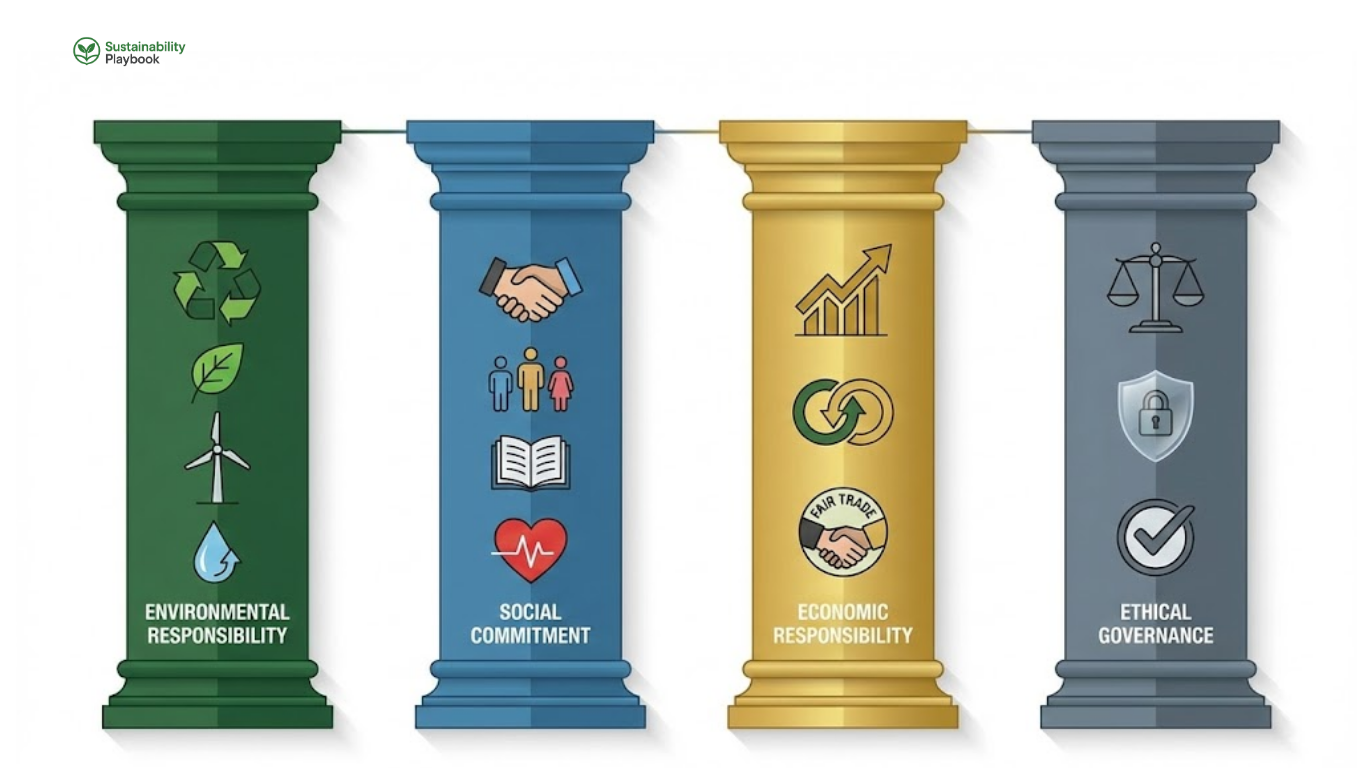
Environmental Responsibility
Environmental responsibility encompasses corporate efforts to minimize ecological footprints through sustainable resource management, emissions reduction, waste minimization, and biodiversity protection. [6] European companies increasingly adopt circular economy principles, renewable energy transitions, and science-based climate targets aligned with the Paris Agreement and EU Green Deal objectives. [3] This pillar addresses climate change mitigation, pollution prevention, and natural resource conservation as fundamental business imperatives rather than compliance burdens. [5]
Social Commitment
Social commitment focuses on a company's impact on people, including employees, communities, customers, and vulnerable populations throughout value chains. [6] This pillar encompasses fair labor practices, workplace health and safety, diversity and inclusion initiatives, community engagement, human rights protection, and ethical supply chain management. [3] European legislation increasingly mandates due diligence on social impacts, particularly regarding labor rights and modern slavery prevention across global operations. [7]
Economic Responsibility
Economic responsibility involves conducting financially sustainable business that generates value for shareholders while contributing to broader economic development without exploiting stakeholders or depleting resources. [6] This includes transparent financial reporting, ethical investment practices, fair taxation, anti-corruption measures, and supporting local economies through responsible procurement and employment. [3] The economic pillar recognizes that long-term profitability depends on healthy ecosystems, stable societies, and trustworthy governance structures. [8]
Ethical Governance
Ethical governance establishes accountability frameworks through transparent decision-making processes, board diversity, stakeholder engagement mechanisms, anti-bribery policies, and compliance systems. [6] Strong governance ensures CSR commitments translate into measurable actions with oversight preventing greenwashing and ensuring integrity throughout corporate hierarchies. [2] European companies face increasing scrutiny regarding governance quality as regulators recognize it as foundational to authentic sustainability performance. [5]
CSR Regulations in Europe
The European Union has established the world's most comprehensive regulatory framework for corporate sustainability, transforming CSR from voluntary initiative to legal obligation for thousands of companies. [2] The Corporate Sustainability Reporting Directive (CSRD), which entered into force in 2024, represents the cornerstone of this regulatory evolution, requiring eligible companies to disclose detailed information about environmental and social impacts using standardized European Sustainability Reporting Standards (ESRS). [4]

Under CSRD, approximately 50,000 European companies must publish sustainability reports covering environmental matters, social concerns, employee welfare, human rights, anti-corruption measures, and diversity metrics. [2] However, recognizing implementation challenges, the EU adopted a "stop-the-clock" directive in April 2025 postponing reporting timelines for wave two and wave three companies. [4] Furthermore, the February 2025 Simplification Omnibus proposal suggests limiting CSRD applicability to companies with over 1,000 employees, potentially exempting 80% of previously covered entities while focusing obligations on organizations with greatest societal and environmental impacts. [4]
CSR vs Sustainability Reporting
While often used interchangeably, CSR and sustainability reporting represent distinct but complementary concepts within corporate responsibility frameworks. [2] CSR encompasses the broader philosophy and voluntary commitments companies make regarding social, environmental, and ethical responsibilities beyond legal minimums. [1] Sustainability reporting, conversely, refers to the formalized disclosure of environmental, social, and governance (ESG) performance using standardized frameworks and metrics. [9]
Under the CSRD framework, sustainability reporting has become a mandatory compliance requirement for eligible European companies, transforming what was previously voluntary CSR communication into legally binding disclosure obligations. [2] The European Sustainability Reporting Standards (ESRS) provide detailed requirements covering materiality assessments, double materiality principles, value chain impacts, and forward-looking information that exceed traditional CSR report scope. [9] This regulatory evolution positions sustainability reporting as the accountability mechanism ensuring CSR commitments translate into measurable, verifiable performance disclosed to stakeholders. [4]
CSR vs CSV
The distinction between Corporate Social Responsibility (CSR) and Creating Shared Value (CSV) represents a fundamental difference in strategic approach to business-society relationships. [8] CSR traditionally positions social and environmental initiatives as philanthropic activities or risk mitigation measures separate from core business operations, often managed through corporate foundations or sustainability departments with limited integration into profit-generating strategies. [10]
CSV, introduced by Harvard professors Michael Porter and Mark Kramer, reconceptualizes the relationship between business success and social progress as mutually reinforcing rather than trade-offs. [8] CSV strategies identify business opportunities that simultaneously generate economic value and address societal needs through innovation in products, processes, and business models. [10] For example, a CSV approach might develop affordable nutritious products for underserved markets, creating new revenue streams while improving public health, whereas a CSR approach might donate profits to nutrition programs without changing core business models. [8]
| Aspect | CSR (Corporate Social Responsibility) | CSV (Creating Shared Value) |
|---|---|---|
| Focus | Philanthropy, reputation, compliance [8] | Business-society value creation [10] |
| Integration | Separate from core business strategy [8] | Integrated into competitive strategy [10] |
| Funding | Uses profit allocation or budgets [8] | Generates profit through innovation [10] |
| Measurement | Social impact metrics, reputation scores [11] | Business KPIs and social outcomes [8] |
| Objective | Doing good, stakeholder expectations [8] | Competitive advantage, market expansion [10] |
CSR Activities and Examples
European companies implement diverse CSR activities spanning environmental protection, social welfare, ethical governance, and community engagement. [6] Environmental initiatives include transitioning to renewable energy, implementing circular economy principles, reducing carbon emissions through science-based targets, and investing in biodiversity restoration projects. [3] Many organizations have committed to net-zero emissions by 2050, aligning with European Climate Law requirements and demonstrating environmental leadership. [5]
Social CSR activities encompass fair labor practices including living wages above statutory minimums, comprehensive health and safety programs, diversity and inclusion initiatives promoting gender equality and minority representation, and skills development through employee training programs. [6] Supply chain responsibility has become increasingly prominent, with companies conducting human rights due diligence, ensuring fair trade practices, and collaborating with suppliers to improve working conditions throughout value chains. [7] Community engagement examples include supporting local education programs, partnering with social enterprises, volunteering initiatives, and transparent stakeholder dialogue processes. [3]
Who Must Implement CSR
Under current EU regulations, CSR implementation requirements vary based on company size, listing status, and sector. [2] The CSRD originally applied to companies with more than 250 employees and €50 million in turnover or €25 million in total assets, plus all companies listed on EU-regulated markets except micro-enterprises. [4] This framework captured approximately 50,000 European companies across three implementation waves beginning in 2024. [2]
However, the February 2025 Simplification Omnibus proposal seeks to significantly reduce this scope, limiting mandatory CSRD reporting to companies exceeding 1,000 employees. [4] This revision would exempt approximately 80% of companies previously covered while concentrating regulatory burden on larger organizations with proportionally greater environmental and social impacts. [4] Additionally, third-country undertakings generating €150 million revenue in the EU with at least one subsidiary or branch meeting specific thresholds must comply with adapted reporting requirements. [2] Even companies below mandatory thresholds increasingly adopt CSR practices voluntarily to meet investor expectations, customer demands, and talent attraction objectives. [3]
Business Benefits of CSR
Implementing comprehensive CSR strategies delivers tangible business advantages extending beyond compliance and reputation management. [3] Enhanced brand reputation represents a primary benefit, as 73% of consumers prefer purchasing from socially responsible companies and sustainability credentials increasingly influence purchasing decisions across European markets. [5] Strong CSR performance differentiates companies in competitive markets, building customer loyalty and premium positioning. [1]
Talent attraction and retention improve significantly through CSR commitment, particularly among younger generations prioritizing employer values and purpose-driven work. [3] Companies with strong sustainability profiles report lower employee turnover, higher engagement scores, and enhanced ability to recruit top talent. [5] Risk mitigation constitutes another critical benefit, as comprehensive CSR frameworks identify and address environmental, social, and governance risks before they escalate into regulatory violations, litigation, or reputational crises. [3]
Financial performance correlates positively with CSR maturity, as studies demonstrate companies with strong ESG performance experience better stock performance, lower capital costs, and improved operational efficiency. [5] Access to sustainable finance continues expanding, with €590 billion in EU green bonds issued in 2024, providing preferential financing to companies demonstrating credible sustainability commitments. [3] Innovation opportunities emerge through sustainability-focused research and development, driving new products, services, and business models aligned with circular economy principles and changing consumer preferences. [1]
EU Supply Chain Due Diligence
The Corporate Sustainability Due Diligence Directive (CSDDD) represents landmark EU legislation requiring companies to identify, prevent, mitigate, and account for adverse human rights and environmental impacts throughout their value chains. [7] Adopted in 2024, the CSDDD establishes mandatory due diligence obligations extending beyond direct operations to upstream suppliers and downstream business relationships. [12]
The directive applies to EU companies with over 500 employees and €150 million global turnover, plus third-country companies generating €300 million EU revenue, covering approximately 13,000 organizations. [7] Required due diligence includes integrating sustainability into policies, identifying actual and potential impacts through risk assessments, preventing or mitigating adverse impacts, establishing complaint mechanisms, monitoring effectiveness, and publicly communicating progress. [12] Companies must also adopt climate transition plans aligned with limiting global warming to 1.5°C consistent with Paris Agreement goals. [7]
Non-compliance carries significant consequences including civil liability for damages, administrative penalties up to 5% of global turnover, and exclusion from public procurement. [7] The CSDDD elevates supply chain responsibility from voluntary CSR initiative to legal obligation, requiring companies to fundamentally transform procurement practices, supplier relationships, and value chain governance to ensure compliance. [12]
CSR Report Contents
Comprehensive CSR reports under CSRD requirements must disclose information across multiple sustainability dimensions using standardized European Sustainability Reporting Standards (ESRS). [2] Environmental disclosure includes climate change mitigation and adaptation strategies, greenhouse gas emissions across Scopes 1, 2, and 3, energy consumption and renewable energy usage, pollution prevention measures, water and marine resource management, circular economy initiatives, and biodiversity protection efforts. [9]
Social reporting encompasses workforce-related matters including employment practices, working conditions, equal opportunities, training and development, health and safety performance, and social dialogue mechanisms. [2] Value chain worker considerations require disclosure of labor practices throughout supply chains, including human rights due diligence and remediation processes. [7] Community impact reporting covers affected communities, consumer protection, and end-user welfare. [9]
Governance components include business conduct disclosures covering anti-corruption policies, political engagement transparency, supplier relationship management, and whistleblower protection mechanisms. [2] Reports must apply double materiality assessment, addressing both impact materiality (company effects on people and environment) and financial materiality (sustainability impacts on company performance). [9] Forward-looking information including targets, action plans, and transition strategies must accompany historical performance data. [4]
Measuring CSR Performance
Effective CSR measurement requires establishing key performance indicators (KPIs) aligned with organizational priorities, stakeholder expectations, and reporting frameworks. [11] Environmental KPIs include carbon footprint metrics measuring greenhouse gas emissions intensity per revenue unit, energy efficiency ratios, waste diversion rates, water consumption intensity, and biodiversity impact assessments. [3] Social metrics encompass employee satisfaction scores, diversity ratios across organizational levels, pay equity measurements, health and safety incident rates, training hours per employee, and supply chain audit results. [11]
The Global Reporting Initiative (GRI) Standards remain the most widely adopted sustainability reporting framework, providing comprehensive guidance on disclosure topics, management approaches, and performance indicators. [13] GRI's modular structure allows organizations to select relevant standards based on material topics identified through stakeholder engagement and impact assessment. [13] For European companies subject to CSRD, the European Sustainability Reporting Standards (ESRS) provide mandatory requirements superseding voluntary frameworks while maintaining alignment with GRI principles. [9]
Robust measurement systems integrate qualitative and quantitative data, establish baseline performance, set time-bound targets, and implement regular monitoring processes with third-party assurance to ensure credibility. [11] Leading companies link CSR performance metrics to executive compensation, demonstrating accountability and driving organizational commitment to sustainability objectives. [3] Digital platforms and ESG data management systems increasingly facilitate real-time tracking, automated reporting, and benchmarking against sector peers. [5]
Stakeholder Engagement in CSR
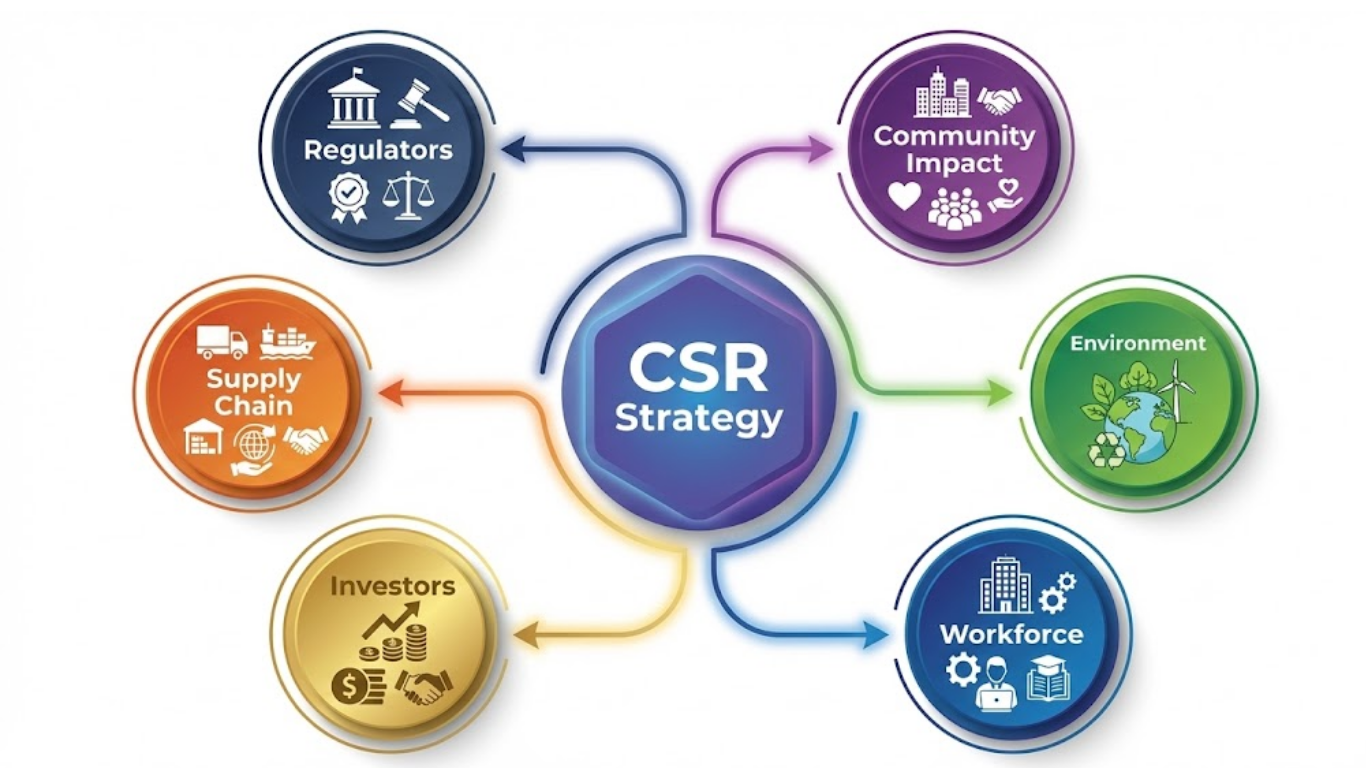
Stakeholder engagement forms the foundation of effective CSR strategy, ensuring corporate initiatives address material concerns and create shared value across diverse interest groups. [1] Key stakeholder categories include employees, customers, investors, suppliers, local communities, regulators, civil society organizations, and future generations whose interests companies must consider in decision-making processes. [3]
Effective engagement employs diverse mechanisms tailored to stakeholder groups: employee surveys and works councils, customer feedback systems and advisory panels, investor roadshows and sustainability-focused shareholder meetings, supplier collaboration programs and capacity building, community consultations and partnership initiatives, and multi-stakeholder dialogues addressing systemic challenges. [1] Transparent communication through sustainability reports, dedicated websites, and regular updates builds trust and demonstrates responsiveness to stakeholder concerns. [2]
Materiality assessment represents a critical stakeholder engagement output, systematically identifying sustainability topics most significant to business success and stakeholder wellbeing. [9] Under CSRD's double materiality principle, companies must assess both impact materiality (effects on people and environment) and financial materiality (effects on business value), requiring comprehensive stakeholder input to ensure complete perspective. [4] Regular stakeholder engagement enables companies to anticipate emerging issues, adapt strategies to changing expectations, and maintain social license to operate in increasingly demanding regulatory and market environments. [3]
Frequently Asked Questions (FAQs)
Corporate Social Responsibility (CSR) represents a company's voluntary commitment to conduct business ethically while positively impacting society and the environment beyond legal compliance requirements. In Europe, CSR has transitioned from philanthropic gestures to a fundamental business framework that integrates environmental stewardship, social equity, economic viability, and ethical governance into core operations.
The four main pillars of CSR are: 1) Environmental Responsibility - minimizing ecological footprints through sustainable resource management and emissions reduction, 2) Social Commitment - focusing on fair labor practices, diversity, human rights, and community engagement, 3) Economic Responsibility - conducting financially sustainable business that generates value while supporting local economies, and 4) Ethical Governance - establishing accountability through transparent decision-making, board diversity, and compliance systems.
Yes, CSR reporting is mandatory for certain companies in Europe under the Corporate Sustainability Reporting Directive (CSRD). The February 2025 Simplification Omnibus proposal limits mandatory CSRD reporting to companies with over 1,000 employees, exempting approximately 80% of previously covered entities. However, the directive still applies to all companies listed on EU-regulated markets except micro-enterprises and third-country undertakings generating €150 million revenue in the EU.
CSR encompasses the broader philosophy and voluntary commitments companies make regarding social, environmental, and ethical responsibilities beyond legal minimums. Sustainability reporting refers to the formalized disclosure of ESG performance using standardized frameworks and metrics. Under the CSRD framework, sustainability reporting has become a mandatory compliance requirement for eligible European companies, transforming what was previously voluntary CSR communication into legally binding disclosure obligations.
CSR traditionally positions social and environmental initiatives as philanthropic activities separate from core business operations. CSV (Creating Shared Value), introduced by Harvard professors Michael Porter and Mark Kramer, reconceptualizes the relationship between business success and social progress as mutually reinforcing. CSV strategies identify business opportunities that simultaneously generate economic value and address societal needs through innovation, integrating social impact into competitive strategy rather than treating it as a separate initiative.
CSR activities include environmental initiatives like transitioning to renewable energy, implementing circular economy principles, and reducing carbon emissions. Social activities encompass fair labor practices including living wages, health and safety programs, diversity and inclusion initiatives, and skills development. Supply chain responsibility includes conducting human rights due diligence and ensuring fair trade practices. Community engagement examples include supporting local education programs, partnering with social enterprises, and transparent stakeholder dialogue processes.
Under current EU regulations, the CSRD originally applied to companies with more than 250 employees and €50 million in turnover or €25 million in total assets, plus all companies listed on EU-regulated markets. However, the February 2025 Simplification Omnibus proposal limits mandatory CSRD reporting to companies exceeding 1,000 employees, exempting approximately 80% of previously covered companies. Third-country undertakings generating €150 million revenue in the EU with qualifying subsidiaries must also comply.
CSR benefits include enhanced brand reputation as 73% of consumers prefer socially responsible companies, improved talent attraction and retention particularly among younger generations, risk mitigation by identifying governance risks early, positive financial performance correlation through better stock performance and lower capital costs, access to sustainable finance with €590 billion in EU green bonds issued in 2024, and innovation opportunities through sustainability-focused R&D driving new products and business models.
The Corporate Sustainability Due Diligence Directive (CSDDD), adopted in 2024, requires companies to identify, prevent, mitigate, and account for adverse human rights and environmental impacts throughout value chains. The directive applies to EU companies with over 500 employees and €150 million global turnover. Required due diligence includes integrating sustainability into policies, conducting risk assessments, establishing complaint mechanisms, and publicly communicating progress. Non-compliance carries penalties up to 5% of global turnover.
CSR reports under CSRD must disclose environmental information including climate strategies, GHG emissions across Scopes 1-3, energy consumption, pollution prevention, water management, and biodiversity protection. Social reporting covers workforce matters, working conditions, equal opportunities, health and safety, and value chain labor practices. Governance components include anti-corruption policies, political engagement, supplier relationships, and whistleblower protection. Reports must apply double materiality assessment and include forward-looking targets and transition strategies.
CSR performance is measured through KPIs including environmental metrics like carbon footprint, energy efficiency ratios, waste diversion rates, and water consumption intensity, plus social metrics including employee satisfaction, diversity ratios, pay equity, and safety incident rates. The Global Reporting Initiative (GRI) Standards remain the most widely adopted framework. For European companies subject to CSRD, the European Sustainability Reporting Standards (ESRS) provide mandatory requirements with third-party assurance to ensure credibility.
Stakeholder engagement forms the foundation of effective CSR strategy. Key stakeholders include employees, customers, investors, suppliers, local communities, regulators, and civil society organizations. Effective engagement employs mechanisms like employee surveys, customer feedback systems, investor roadshows, supplier collaboration programs, and community consultations. Materiality assessment represents a critical output. Under CSRD's double materiality principle, companies must assess both impact materiality (effects on people and environment) and financial materiality (effects on business value).
Ready to Advance Your CSR Strategy?
Understanding CSR requirements and implementing effective sustainability practices positions your European business for regulatory compliance, stakeholder trust, and competitive advantage in 2025 and beyond. Stay informed about evolving EU regulations and best practices to ensure your organization leads in corporate responsibility.
References and Sources
About the Author
Prashant Sharma
Student of Sustainable Business & Law. Exploring ESG compliance, environmental regulations, and corporate sustainability. Dedicated to making sustainable practices accessible and understandable.